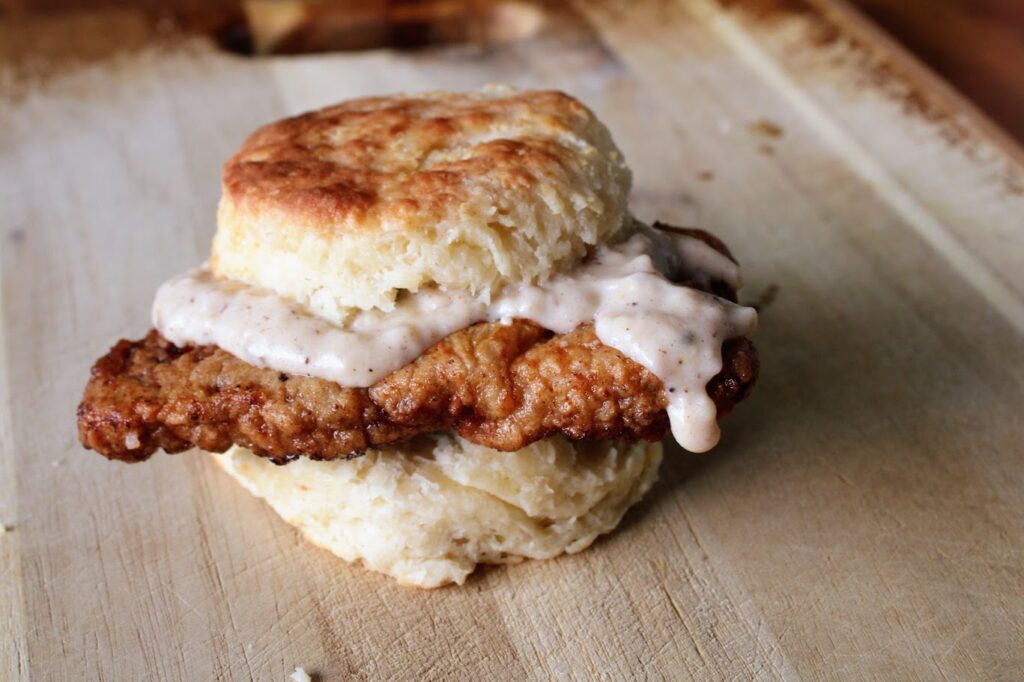
It’s time to visit one of the forgotten warriors of Southern fast-food biscuit sandwich menus. This is the humble fried steak biscuit that seems to lurk in the mid-tier of the breakfast menus at Bojangle’s, Hardee’s, Biscuitville, and other biscuit-focused fast-food restaurants. It’s never first in the line-up, but it’s typically not last either.
My goal in this sandwich blog post is to create a recipe for a much better version of a steak biscuit, while at the same time writing about the importance of buttermilk, an ingredient that you may or may not keep in your fridge. And we’ll explore how you can recreate buttermilk with regular milk and some commonly available pantry products.


Is the steak biscuit worthy of being in the number one spot on the breakfast menus? Maybe not when it’s produced in a chain restaurant, but when you make it yourself, I think it’s deserving.
What is this sandwich?
This is a fried steak biscuit sandwich that’s similar to but not necessarily intended to be a copycat recipe of any particular chain offering. The base of the sandwich is tenderized cube steak that has been cut and pounded to sandwich size, buttermilk-marinated, and then breaded with seasoned flour and fried until golden brown, with a crispy, flavorful exterior.
The steak is sandwiched in between a fluffy, flaky buttermilk biscuit, and if you’re extra ambitious, I will demonstrate how to easily make a quick cream gravy that will simultaneously smother and elevate what could be a mid-tier sandwich experience to the upper levels of fast food menus.

Smothered steak?
Last year, in early November 2025, Bojangle’s launched their new smothered steak biscuit. This is basically just a combination of two things that already exist in the form of their fried steak biscuit and the creamy sausage gravy that they serve if you order biscuits and gravy. In the press release (linked above), they mention country-fried steak, which in Southern-style restaurants is typically served with cream gravy, but it’s not usually sausage gravy, and as you’ll see, I’m not making a pork sausage-flavored gravy for my biscuits either.
I wrote about country-fried steak and gravy inside of Texas toast a few years back. That’s a great sandwich, but it’s even better in biscuit format.

If you’re making your own biscuits and frying your own biscuit-sized piece of steak, you probably do not also want to cook up some ground sausage that you would then turn into gravy. Luckily, you don’t really need sausage to create a good cream gravy; you just need fat, flour, and liquid. I’ll cover the gravy technique a bit further down the page, but just know that no sausage is needed here.
If you’d like to make a sausage gravy, I have a recipe for that as well, but this particular sandwich goes without because the sausage would be extra work and extra unnecessary ingredients.
Biscuitville’s fried steak biscuit
I live in Chicago, where the biscuit-focused restaurants are few and far between. We’re supposedly getting a Bojangles in the suburbs at some point, but even that won’t really be very convenient for me, so I am stuck getting my fast-food biscuit experiences around the holidays when I’m visiting family in North Carolina.
I wanted to get a baseline for this sandwich blog post, so back in December, I got a chance to try a fast-food fried steak biscuit.
My usual spot that I visit is Bojangles for their chicken filet combo that I reconstructed at home in 2022. But this past holiday season, I chose to visit Biscuitville (directly next to our hotel) and gave them a chance to wow me with their steak biscuit. Turns out, it was pretty good. The steak was tender to the point where it sort of seemed like it was made from ground beef. The fried breading stayed on the meat and had a little bit of crispiness. The biscuit was buttery and soft, and overall, the sandwich was pretty satisfying.


I did not make it to Bojangles’ to try their steak biscuit on that trip, but I have had one quite a few times over the years. The Biscuitville steak biscuit was at least as good as Bojangles’s, so I might end up hitting Biscuitville a bit more going forward when I’m visiting relatives and need that biscuit fix.


Now that we know what sandwich we’re shooting for, I’d like to cover some reasons why the textures and flavors of this steak sandwich might rely more on a certain type of liquid than it does on the steak itself.
What is buttermilk?
Buttermilk is a liquid created by adding lactic acid bacteria to milk to produce a fermented, sour milk. Before refrigeration was invented, buttermilk was traditionally made from the non-fat milk extract that is produced when butter is churned from cream. During that process, the butter fats are extracted from cream, leaving behind something similar to skim milk. Acidity is added, which gives the non-fat milk a sour, fermented taste. In current times, buttermilk is made from fresh, pasteurized milk, and you can buy it in different fat contents just like regular milk.

In some cultures, people drink buttermilk because the fermentation process enables it to stay fresh for a longer period of time than regular milk, but in the United States, buttermilk seems to primarily be used in cooking or recipes. The acidity of buttermilk performs two distinct jobs that both pertain to a homemade steak biscuit sandwich.
First, the acidity in buttermilk activates when it comes into contact with sodium bicarbonate, which is a primary ingredient in baking powder. The combination of acid and bicarbonate creates a reaction that causes bubbles of carbon dioxide to be released. This chemical reaction is crucial to making biscuits or other forms of bread or batters because the bubbles of gas help to create lift in the final baked goods.
Second, buttermilk’s acidity also helps to tenderize meat when it’s used as a marinade. You’ll often see buttermilk used as the base of a marinade for fried chicken, and this isn’t just for flavor. The acid in buttermilk helps to denaturize meat by breaking down some of the proteins and tenderizing it. A popular YouTube food content creator named Adam Ragusea has a good video explaining what acid does in a marinade. Very much worth a watch if you want to learn more.
Substitutes for buttermilk?
Buttermilk has a longer shelf life than regular milk, but it’s probably not an ingredient that you keep in your fridge all the time. If you ever catch your fridge buttermilk-less and you need to make some biscuits, you still have a couple of options.
Use milk and vinegar or lemon juice.
Formula: 1 tablespoon white vinegar or lemon juice + 1 cup milk = stir and let sit 10 to 15 minutes, and you should have something that will bring acid, much like buttermilk, to provide lift to your biscuits.
Use milk and plain yogurt.
Formula: 1/4 cup milk + 3/4 cup plain yogurt = buttermilk substitute that should have enough acidity to tenderize meat and activate bicarbonate.
Keep buttermilk powder in the pantry.
This one is easy, but it does require a bit of pre-planning. Buttermilk powder is a shelf-stable ingredient that has a multiple-year shelf life, and you can mix the powder in with water to create a facsimile of buttermilk. I have used this many times, and it works just fine with biscuits to provide the acid needed to boost the baking powder and activate the lift needed to help biscuits rise.


Freeze buttermilk?
I do not do this, but apparently freezing buttermilk is also a good option. I would suggest portioning out the buttermilk into cup or half-cup portions before freezing, though, so that you can grab what you need to thaw for a recipe.
Now that we know what sandwich we’re making and what all we can do with buttermilk, let’s make some tender, flaky, super buttery buttermilk biscuits.
Buttermilk biscuits
I have made quite a few biscuits on this sandwich blog. I have a whole section of the site dedicated to biscuit tips and all of the many different recipes I have created and shared. The biscuits that I made for these fried steak and gravy sandwiches aren’t fancy, though. These are the normal buttermilk biscuits that I’ve been making for many years, and I have refined the techniques with tips throughout the recipe.
The main bulk of the recipe calls for self-rising flour, but I know that everyone doesn’t make biscuits often enough to keep self-rising in stock, so in the tips below the recipe, I have measurements that are needed for using all-purpose flour and baking powder.
Check the dates on your self-rising flour or baking powder before you start to bake.


As I wrote above, buttermilk plus baking powder creates a reaction that produces carbon dioxide, which gives rise and lift to a buttermilk biscuit recipe. But you also need to remember that the butter itself plays a big part in the flakiness of biscuits.
Butter melts in the heat of the oven and basically turns into a fatty liquid that soaks into the dough. But if it’s layered properly, the butter leaves behind air pockets when it melts, which helps to lighten the finished biscuits. This is why it’s super important to start with very cold butter, and throughout the process, it’s even beneficial to put the dough back in the fridge or freezer to keep that butter cold right up to the moment where it goes into the oven.


I created a recipe that attempts to copy Bojangles’ version of biscuits for my Cajun filet biscuit recipe, but honestly, it’s not as good as my other buttermilk biscuit recipe that’s just below. But you can try this Bojangles’ recipe if you want to make your own decision.
Bojangles buttermilk biscuits (copycat)
2 hours and 35 minutesHere’s my buttermilk biscuit recipe, and this is the one that I would recommend you use if you want a great batch of savory, soft, and buttery biscuits.

Buttermilk biscuits
Adapted from Southern Living's best buttermilk biscuits recipe. This is a super easy biscuit recipe, requiring only three ingredients plus a pinch of love.
Get RecipeCountry-fried cube steak
Cube steak is the type of beef that is most likely what all of these fast-food steak biscuits are made from. Cube steak is less about the cut of beef; it’s about the process used to tenderize that beef. Most cube steaks come from the top round, eye of round, or top sirloin, from the rear of the cow. The name cube steak comes from the process that takes place at the butcher shop, where they use a machine to cut indents into the steak for the purpose of tenderizing a tough meat to make it easier to cook.
For a biscuit sandwich, I think it’s important to ensure that the meat is around 1/4 inch thick. This meant that I had to pound the meat that I purchased just a bit more than it was when I removed it from the package. Your mileage here may vary, but I think you don’t really want a super thick piece of meat in a biscuit.


As I have already written way up in the buttermilk explanation section, the acids in the liquid will help to tenderize cube steak even more. If possible, you should keep the meat in the marinade for more than 4 hours or up to overnight to get the best results from this form of tenderizing.
I also add some salt and black pepper into the buttermilk to make sure that there is some seasoning that will hopefully integrate into the meat just a little. The flour that we’re coating the steak with will be extra seasoned, but it would be best if you could introduce some seasoning directly on the meat as well.


Once the cube steak has been marinated in buttermilk, and it’s time to fry, you need to season some all-purpose flour and use the leftover buttermilk marinade to ensure that the flour is able to stick to the meat very well.
I double-bread the cube steak, but you don’t have to if you think you might prefer a thinner exterior crust. To double bread the meat, you simply have to move the cube steak from the buttermilk, coat it fully with flour, then back into the buttermilk before coating it a final time in the seasoned flour. This just ensures that you have a nice coating that will retain crunch inside the biscuit and underneath some creamy gravy.

The frying process is fairly simple. I add about 1/2 inch of oil in a 10 to 12 inch skillet and bring the oil up to about 350 F (175 C). If you do not have a thermometer (you should get one), you can use a small pinch of flour and sprinkle it into the oil. If the flour sizzles immediately after you sprinkle it in the oil, it should be hot enough.
Fry the steaks for about 3 minutes and then flip and fry another 3 minutes on the second side. Then move the steaks to a cooling rack to rest for at least 5 minutes or just enough time to make gravy before sandwiching.
Cream gravy
I’ve written about gravy a lot. It’s basically a version of a mother sauce created by combining fat, flour, and a liquid. In this situation, we use some of the fat and drippings from frying the steak, all-purpose flour, and regular milk. You could probably use buttermilk, but creating gravy reduces the liquid and will intensify the sourness in the buttermilk, so I wouldn’t suggest it.
In my experience, the ratio of fat to flour to liquid is 2:2:16. This works out to 2 tablespoons of fat, 2 tablespoons of all-purpose flour, and 16 tablespoons (or one cup) of milk. You might end up needing a bit more milk (or the liquid of your choosing), but typically those numbers will work out. It is smart to make sure you have extra milk just in case you need to thin out the gravy, and if you expect to warm the gravy up later, you will definitely need more milk or water to get the texture right.


Steak biscuit art
I took last week off from sharing a sandwich because I’m trying to retain what is left of my mental stability. This blog and these recipes aren’t my full-time job; they’re an extended hobby that gives me an outlet to unload some of my creative thoughts that are bouncing around in my head. At some point last year, I bought a stylus for my tablet, downloaded a few different illustrating apps, and started drawing sandwiches at night while my wife and I watch tv.
I’ve started compiling the art I’ve created for this blog with links to the blog posts that feature the artwork on a Sandwich Art page. The pieces of art are in order from most recent at the top to the ones I painted first, and you can really see the difference.
When I was a kid, I used to do a lot of drawing, and I took a few painting/art classes throughout my youth, but that was decades ago, and I don’t really know what I’m doing at this point. But I’m having fun!
Because I had more than a week to prepare this particular steak biscuit blog post, I had a few extra nights and the energy to create a couple of extra digital biscuit sandwich paintings to share. The green one was created with just the “gouache” brush of different sizes, and the blue one was created using just “watercolor” brushes. Typically, I just go hog wild and use all sorts of brushes or textures to create, but this time I wanted to be a bit more specific to see if I could make biscuit sandwiches that were similar but looked very different.
When I was about to go off to college, I had aspirations to do something in design or art, and I took a painting class from a local artist. She felt I should use gouache as my medium for the class. Gouache is pretty easy to work with, and it is sort of like an opaque watercolor.


Ok, enough artsy fartsy nonsense, here are the smothered steak biscuit sandwiches that I made and the recipe.
Smothered country-fried steak biscuit photos and recipe
I probably made too many of these smothered steak biscuit sandwiches over the past week. It was a very enjoyable week, though. Here are a bunch of photos of the sandwiches that I made. Some with and some without cream gravy, but they all had a tender, crunchy steak filet inside of a biscuit that Biscuitville biscuit cooks would be proud of.
Scroll through to check out the photos and get the full recipe for the biscuit and sandwich just down below.


Country-fried smothered steak biscuit sandwich

This recipe tucks a savory and crispy fried steak, smothered by a warm and creamy gravy, into a buttery and flaky biscuit sandwich experience that will beat the pants off of any fast-food breakfast sandwich you've ever had.
Ingredients:
Buttermilk biscuits- 2.5 cups self rising flour (300 grams)
- 1 stick of frozen butter (grated - 4 ounces/113 grams)
- 1 cup cold buttermilk (224 grams)
- 2 tablespoons melted butter (to be painted on top after baking)
- 2 pieces of sandwich sized cube steak, pre-tenderized (around a pound total)
- 3⁄4 cup buttermilk
- 2 teaspoons salt (divided)
- 2 teaspoons ground black pepper (divided)
- 1 cup all purpose flour
- 1 teaspoon paprika
- 1⁄2 teaspoon onion powder
- 1⁄2 teaspoon garlic powder
- 1⁄2 teaspoon cayenne pepper powder
- 1⁄4 teaspoon MSG (optional)
- canola or vegetable oil (for frying - 1/2 inch deep in a pan)
- 2 tablespoons frying grease (from above)
- 2 tablespoons all-purpose flour
- 1 cup whole milk
- 1⁄2 teaspoon salt
- 1⁄2 teaspoon ground black pepper
Suggested Equipment
Directions:
Buttermilk biscuits: preheat oven to 475 F (245 C).
Measure or weigh your flour. Grate frozen butter into the sifted self-rising flour. Stir to combine until the butter is fully coated by flour.
Put the bowl in the freezer for 10 minutes. It's important to keep the butter as cold as possible through this process.
Combine buttermilk with the cold flour/butter to bring it together as a dough. Stir no more than 15 times. Overworking the dough at this stage could cause your finished biscuits to be more tough. Your dough at the end of 15 stirs will be very shaggy and not smooth at all.
On a floured surface, dump out the dough and roll it with a rolling pin. If you don't have a rolling pin, you can just use your hands. Dust with flour as needed when the dough gets sticky. Fold the dough over on itself five different times. This folding process is what creates the layers in the biscuits.
Roll or flatten the dough to 3/4 to 1 inch thick/tall.
Cut biscuits into circles or squares and place on a parchment paper-lined baking sheet. If you have a set of biscuit cutters, I prefer the 3-inch diameter cutter for biscuit sandwiches. When cutting, you do not want to twist the cutter. Twisting while cutting will ruin the layers that you created with folding. Place your cut biscuits next to each other (touching) on the sheet pan. Touching biscuits helps each other rise taller.
After cutting biscuits, you can grab any scraps of dough and reroll and re-cut them. There's no need to waste any dough. The last few biscuits might not look as uniform as the first ones, but they will all taste the same.
Bake at 475 degrees F (245 C) for around 15 to 20 minutes. Check around the 12-minute mark to make sure they do not brown too much.
When biscuits are done, transfer them from your baking pan onto a cooling rack to stop the bottoms from cooking further.
Paint the melted butter on top of each biscuit.
Country-fried steak: In a medium bowl or zip-top bag, add the steak, buttermilk, 1 teaspoon of salt, and 1 teaspoon of black pepper. This buttermilk should help to tenderize the steak, so you should let it marinate for at least 4 hours or up to overnight.
When you are ready to get started with the frying process, grab two bowls. To the first bowl, pour in the buttermilk from the marinade and the steaks. To the second bowl, add all-purpose flour, 1 teaspoon salt, 1 teaspoon black pepper, paprika, onion powder, garlic powder, cayenne powder, and MSG (if using). Stir everything to combine.
Shake off a piece of steak and add it to the bowl with the flour mixture. Coat the steak thoroughly, making sure that the flour fully coats it and there are no wet spots, uncovered by flour. Then, put the steak back in the buttermilk marinade to get it fully wet before coating in seasoned flour for a final time. This double coats the meat, ensuring that the crust will be crunchy.
Move that fully-floured, dredged piece of steak to a plate to rest. Repeat with the other steak.
Add oil 1/2 deep to a large skillet over medium-high heat.
Add a pinch of flour to the oil, and if it immediately starts to bubble, the heat is right. Add steaks and fry them for 3 minutes on the first side. After 3 minutes, flip and fry the second side for 3 minutes or until the batter of the steak is nice and golden brown.
Once the steak is golden brown to your liking, remove it from the oil and place it on a paper towel-lined plate or a cooling rack to rest. DO NOT discard all of the oil yet.
Cream gravy: Reserve 2 tablespoons of the oil you just used to fry the steaks. Discard the rest of the oil and wipe out your pan.
Add the pan back to medium heat and add the two tablespoons of the reserved oil. Add two tablespoons of all-purpose flour and whisk the flour into the oil. Cook for 1 to 2 minutes to cook off the flour flavor.
Slowly add 1 cup of milk to the pan with the flour mixture. Whisk or stir constantly to ensure that you have no lumps in the gravy.
Add salt and pepper and taste for flavor. If the flavor is good, cook the gravy for 3 or 4 minutes or until the gravy starts to thicken.
Sandwich assembly: Slice a biscuit and toast it if it is cold.
Add one country-fried steak piece into the biscuit and cover with 3 or so tablespoons of gravy. Close the biscuit, serve, and enjoy.
Notes:
You can freeze a batch of biscuits prior to baking, and then when you want to make just one or two biscuits, you can bring them out and cook (still frozen) at 475 degrees F for about 15 minutes. You will want to check around the 12-minute mark and keep an eye on them to see if they are browning fast enough.
If you do not have self-rising flour, you can use all-purpose flour, salt, and baking powder at a rate of 1.5 teaspoons baking powder + 1/4 teaspoon salt to each cup of flour. For this recipe, that would be:
- 1 tablespoon + 3/4 teaspoon baking powder (17 to 18 grams)
- a heaping 1/2 teaspoon salt (2 to 3 grams)
- 2.5 cups of all-purpose flour (300 grams)
Mix the flour, baking powder, and salt together before adding butter.
Check back next week
Next week, I will be making the World’s Greatest Sandwich. Or at least that is what some people say. Is it the world’s greatest? I don’t think so, but it’s still a really good one, and it’s easy too. Come back in a week or subscribe to find out what I’m talking about.



heath says:
These are gorgeous! (And steak biscuits are not mid-tier, in my opinion–they don’t get star billing, but damn they are good. My second favorite after chicken biscuits!) (Speaking of which, if you’re anywhere near Chapel Hill on your next trip home to visit family, you NEEd to go to Sunrise Biscuits and try their chicken and cheese biscuit, their steak and cheese, and their country ham. They’re amazing!)
Jonathan Surratt says:
Thank you! Also I lived in Chapel Hill for a few years in the late 90s/early 2000s. And as a matter of fact I got some Sunrise Biscuit Kitchen back in December. I didn’t see steak as an option on the menu the day I visited though. I think it was out because there was a missing spot on the menu. I got the chicken and cheese and it was just as good as I remembered.
tyler says:
Great timing! This weekend I had some chicken and waffles which had a sage gravy over it which made me want a country fried steak. And maybe a chicken and waffle sandwich. And maybe a country-fried chicken and country-fried steak waffle sandwich??
Jonathan Surratt says:
That sage gravy on chicken and waffles sounds great. Country fried chicken and steak waffle sandwich might get you a special visit from your cardiologist!