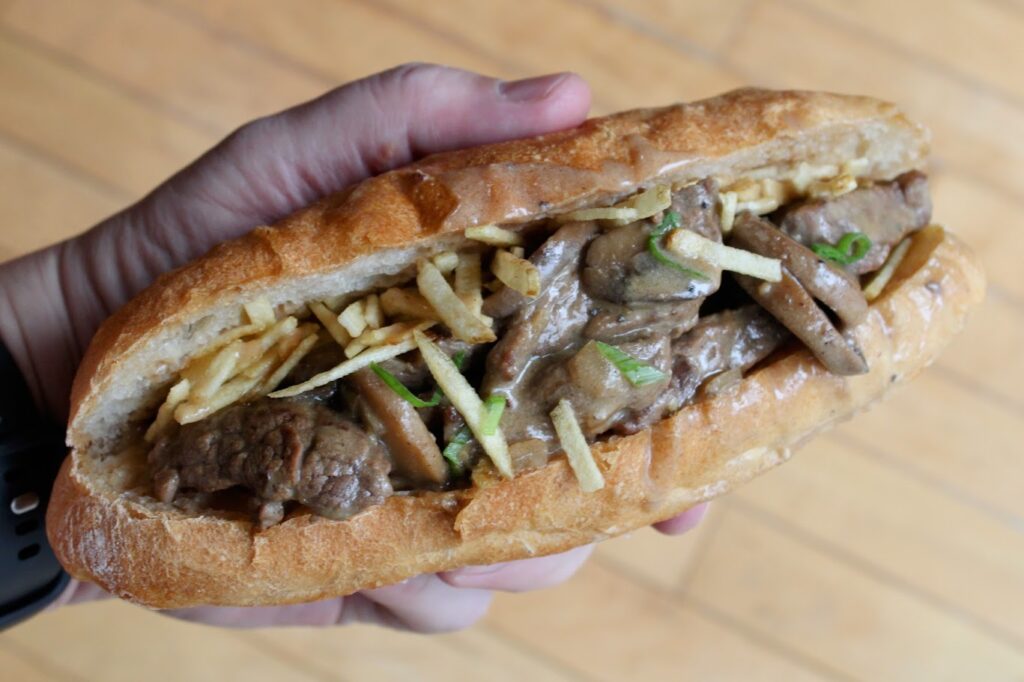
Sometimes I write about traditional sandwiches, sometimes I try to recreate a sandwich from a restaurant or TV show, and sometimes I just make whatever sandwich I feel like making. That’s where we’re at this week. I was recently kicking around sandwich ideas, and I decided I wanted to find out how well a dish I enjoyed while I was a kid worked when stuffed between bread.
Spoiler alert: the sandwich worked pretty well.
What is this sandwich?
This sandwich concept takes a very old and well-known Russian dish of tender beef in a creamy mushroom sauce and adds it to a crusty homemade bread roll, which, as you can imagine, turns into a fantastic sandwich experience.
The dish in question is Beef Stroganoff stuffed inside one of my more popular bread roll recipes, which brings a whole lot of extra texture into tender beef that’s smothered in a creamy mushroom and onion gravy.

History of Stroganoff
Beef stroganoff is not just a flavor of the Hamburger Helper brand of creamy boxed pasta meals; it’s a dish that was invented at some point in the 1800s in Russia. It’s not clear whether it was Russian-born chefs or French-born chefs who originally created the dish, but it was definitely named in honor of one of the members of the Stroganov family, who were Russian nobles at the time.
The Stroganov family was one of the wealthiest merchant families in Russia, dating back to the 1500s. The family financed the conquest of Siberia and the 1612 reconquest of Moscow for Russia against the Poles.
The exact origins of Beef Stroganoff may be murky, but it’s definitely related to the Stronganov family. One very well-considered origin story starts in the home of Alexander Grigorievich Stroganov, who was for many years a Governor-General of Novorossiya starting in 1855 (Novorossiya is a historical name for the Russian state or area that is basically where Ukraine is today). His household lived by an “open table” rule, which meant that they often had drop-in visitors who might come in off the street during dinner to speak with the Governor-General. This led his chefs to create a hybrid Russian-French dish, which was made from small pieces of beef, fried and served in sauce, rather than the sauce served on the side. It was easy to make and portion out for whatever number of possibly random, unexpected guests showed up.
The first mention of the term Beef Stroganoff or “Stroganov meat” was in a Russian cookbook titled “Gift for Young Housewives,” which was released in 1870, fifteen years after Alexander Stroganov became a Governor-General. Other somewhat similar origin stories have been documented fairly well by this Moscow Times article about the history of Beef Stroganoff, if you want to dig further down the rabbit hole.
There are other theories as to which member of the Stroganov family this dish was actually named in honor of. We’ll likely never know which origin story is the correct one, but the dish definitely came from Russia, and its invention was definitely involved in some way with the Stroganov family.
What exactly is Beef Stroganoff?
Beef stroganoff in current times (at least in the United States where I am) is a dish that is typically made from strips of beef or steak that are browned in a skillet, onions garlic and often mushrooms are cooked down as well before flour is added which will help everything thicken into a sauce after you add liquids like beef broth, wine or sometimes even cream.


Sour cream is a big deal in Russian cooking, and it is added near the end of the cooking time to bring creaminess to the final Stroganoff sauce. There are also different flavorings that I have seen in various Stroganoff recipes, such as Dijon mustard, Worcestershire sauce, or even something like beef base (Better than Bouillon) to create a more flavorful sauce or gravy.
Smetana is an English language word that means sour cream in Russia and parts of Eastern Europe. It’s made from soured heavy cream, and it is used in many dishes like a garnish in borscht, served with dumplings, and smetana is always present in Stroganoff.
What to serve with stroganoff?
In the United States, beef stroganoff is typically served on top of wide egg noodles, or sometimes white rice, but I could see it being very nice served on top of or right beside a pile of creamy mashed potatoes. In Russia, stroganoff is often served with potatoes, either mashed or more commonly, crispy matchstick-style fried potatoes.
Now that we know what the main portion of the sandwich will be, we need to make some slightly crunchy, but sturdy bread rolls that can stand up to stroganoff.
A crusty bread roll
This is one of my more popular bread roll recipes, and I believe this is the 12th sandwich I have written about where I used this particular recipe. The recipe creates a sturdy bread roll with a nice crackling crust that will definitely stand up to the addition of gravy. The base of the dough uses bread flour instead of all-purpose flour because it contains extra protein, which leads to a slightly denser finished roll. The density is perfect for a sandwich that has a lot of sauce or gravy.


If you follow the recipe, you’ll see that there’s a slightly complicated oven situation described with spraying the unbaked rolls with water and adding an oven-safe pot with boiling water into the oven to help create any sort of steam that we can. Steam is an important step in baking, but it’s really hard—some might say close to impossible—to get steam into a conventional home oven.


Here’s the recipe I used for this Stroganoff sandwich. If you do not want to make your own bread rolls, just try to find a suitable roll at the store that seems like it might be able to stand up to what is effectively beef and mushroom gravy in Stroganoff.

Chicago-style sub rolls
Similar, but not a full copycat of a Turano brand roll. These are great for Italian beef sandwiches or any other type of sub. There's a thin crunchy and chewy exterior and a nice soft pillowy interior, perfect for a dunk in au jus or gravy.
Get RecipeBeef and mushroom gravy
Stroganoff starts with a big hunk of meat that you cut into strips that will eventually be bite-sized. I like 2-inch by 1/2 inch strips, but just try to keep them all similarly sized if possible so that they cook evenly. The choice of meat varies wildly from recipe to recipe. I try to buy a chuck roast if possible because I like the marbling of that cut of meat, and I think it benefits from a bit of simmering time to tenderize each bite.
After you’ve sliced up the beef, you might as well do the rest of the prep since you have the knife and cutting board out. You’ll need to dice some onions, slice some white mushrooms, and mince 2 or 3 cloves of garlic. Everything ends up cooking in the same pan, so it’s beneficial to have them all prepped before you even start cooking.


Once the meat and veggies are all prepped, grab a large skillet or pan and sear the beef in batches, and set aside in a bowl or plate. You only need to brown the exterior of the meat; it doesn’t have to be cooked all the way through, because that will happen during the simmering that happens during the creation of the Stroganoff sauce. Cook the meat without overcrowding the pan, and then reserve the meat in a bowl, making sure that you do not discard the liquid that will result from resting the beef. That all needs to go back in the pan when it’s time.


Once the meat is all browned on the outside and removed from the pan, reduce the heat and add butter, diced onions, and sliced mushrooms. These all need some time to soften, so you can cook them for about 8 minutes before adding the garlic and all-purpose flour.
The flour is our thickening agent that works alongside the fat from the butter to create a basic roux, which will thicken the beef broth and wine that we will use to create the bulk of the Stroganoff sauce. The browned beef strips and their accompanying liquid will also come back into play, and we will simmer everything for about 20 minutes while the sauce thickens. This simmering time will end up fully cooking the beef while at the same time tenderizing it a bit so that each bite is the correct texture and consistency.

After the simmering process, just before we’re about to be finished, you add sour cream. This also helps with some of the sauce thickening, and it creates a great sauce with some fun creaminess that accompanies the mushroom and beef flavors.


Beef Stroganoff
It's not surprising that this warm and comforting beef and mushroom-focused dish was invented in the colder climates of Russia. The addition of sour cream helps to thicken the broth into a thick gravy, which pairs great with the tender beef.
Get RecipeNoodles in a sandwich?
Since most of my experience with eating stroganoff included noodles, I thought about adding some egg noodles to this sandwich, but ultimately decided against it. I don’t think they would have added anything unless I had fried them to add texture.
Instead of noodles, I had another plan to add an additional component that also brought some big crunch.
Crunchy potato sticks
I felt like the sandwich could use something other than just stroganoff. Since I chose not to focus on noodles, I decided to look to the traditional Russian accompaniment in the form of crispy potatoes.
I chose to buy some crispy shoestring potatoes at the store because I knew they would bring the crunchiness that I wanted. You can try to make these yourself, but you will probably not be able to make them as crunchy as the ones you can buy at the store.


Another addition that would bring some flavor and possibly crunch to the sandwich would be some of those store-bought crispy fried onions or possibly jalapenos if you want a bit of spice. For me, though, these potatoes worked great.
Beef stroganoff sandwich photos and recipe
Here are some photos of the Stroganoff sandwiches I made this week. They were very comforting with multiple flavors and textures coming from the tender beef, crusty bread, and crispy potatoes.
Just past the photos is the full sandwich recipe if you’d like to give it a shot. Let me know how it turns out!


Beef stroganoff sandwich with crispy shoestring potatoes

Tender beef and mushrooms alongside a creamy broth gravy work very well tucked inside a crusty bread roll to create a great sandwich that will help you get through the winter.
Ingredients:
Beef stroganoff- 2 pounds beef chuck roast, cut into 1/2 wide strips
- 3 tablespoons olive or vegetable oil
- 3 tablespoons butter
- 1⁄2 large onion, diced
- 10 ounces white mushrooms, sliced
- 3 cloves garlic, minced
- 2 tablespoons all-purpose flour
- 3 cups beef broth
- 2⁄3 cup white wine
- 1 tablespoon Dijon mustard
- 1⁄2 teaspoon salt
- 1⁄4 teaspoon ground black pepper
- 2⁄3 cup sour cream
- 1 six-inch long, crusty sandwich roll
- beef stroganoff (from above)
- crispy store-bought shoestring potatoes
- green onion or chives, thinly sliced (garnish)
Directions:
Beef stroganoff: slice the beef into 1/2-inch-wide slices that are around 2 inches long.
Add 2 tablespoons of olive or vegetable oil to a large skillet over medium-high heat. Once the oil starts shimmering, without crowding the pan, place slices into the pan and cook each piece of meat for 1 minute per side. Cook the meat in batches, and when one group gets browned, move them out of the pan and into a plate or bowl to rest. Continue cooking the meat until all of it has browned and is moved to the plate or bowl. The meat does not need to be cooked all the way through; it will cook more later.
Do not clean out the pan, but reduce the heat to medium and then add 3 tablespoons of butter along with the diced onions and sliced mushrooms. Cook for 7 to 8 minutes, stirring often until the mushrooms and onions have softened.
Add the minced garlic, stir, and cook for 1 minute. Keep the garlic moving and mixed in with the onions and mushrooms.
After the garlic has cooked for a minute, add 2 tablespoons of flour and cook it for 1 minute, stirring constantly while the flour cooks.
Add the beef broth and white wine and cook until the liquid starts simmering. Once the liquid is simmering and bubbling, add all of the meat back into the liquid along with any residual liquid from the bowl or plate the meat was resting in. Bring the liquid back to a simmer and cook everything for 20 minutes.
After 20 minutes, the meat should have softened some and the liquid should have reduced a bit. Add the Dijon mustard, 1/2 teaspoon salt, and 1/4 teaspoon ground black pepper.
Add the sour cream and cook for 5 additional minutes to make sure everything is warmed through. If the liquid hasn't reduced and the sauce isn't thick enough, you can continue to simmer for an additional 10 minutes or so to help thicken things up. If you think the sauce is too thick, you can add more beef broth or water, 1/4 of a cup at a time.
Sandwich assembly: slice a crusty roll and toast it if it's more than a day old. To do this, I preheat the oven to 350°F (175°C) and bake the roll for 5 minutes.
Add scoops of beef stroganoff and plenty of sauce/gravy, top everything with some crispy store-bought shoestring potatoes, and garnish. Serve with additional sauce for dipping if desired, and enjoy.
Check back next week
Next week, we will be testing a technique for preparing meat that I have seen all over the internet. It’s definitely viral, but hopefully we won’t catch anything deadly.


Bill says:
Meat ain’t cheap, but Slagel Farms meat REALLY ain’t cheap…
Jonathan Surratt says:
haha this is not a lie!