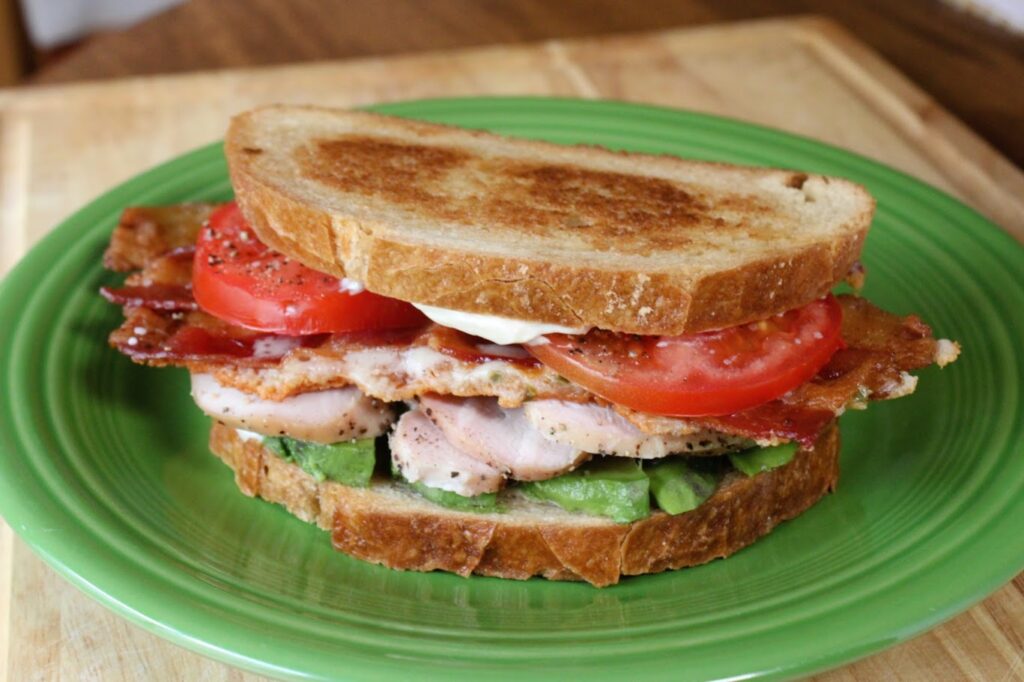
During the first year of this sandwich blog, I wrote about club sandwiches and club-style sub sandwiches with the addition of my 5 tips for making better clubs/subs. Since I am a really big fan of the combination of sliced roast turkey and crispy bacon, I felt it was time to tackle a club sandwich again. But this time, it’s a slight variant.
Along the way, I also demonstrate how to make one of those trendy “cheese skirts” for this club to change things up and give this sandwich a textural and cheesy upgrade.
What is this sandwich?
The sandwich we’re covering today is listed by many restaurant menus as a California club sandwich, or if they’re extra hip, they substitute “Cali” for the state’s full spelling. If you’ve never heard of one of these sandwiches, a rough definition starts with roasted or smoked sliced turkey or chicken, crispy pork bacon, sliced cheese, sliced tomato, sliced or mashed avocado, and mayonnaise in between toasted white bread or sourdough.
Again, I want to reiterate that this sandwich definition is loose.

Some California club sandwiches will have lettuce, some will have microgreens, a dwindling few contain alfalfa sprouts, and often the mayonnaise will be exchanged for a sauce like pesto aioli, or green goddess dressing.
Brief history of the California club sandwich
The California club, being an offshoot of a regular club sandwich, means that it will clearly have a later introduction to history than the original, but it still has roots going back more than 70 years.
Digging into archive.org, I found two examples of recipes for a California club sandwich in different printed media from the early 1950s. Both recipes are fairly different from each other, but they do have two things in common: the inclusion of avocado and bacon.
A regular—non-California-style—Club sandwich has a history going back at least as far as 1894. If you want to read more about that, check out the Sandwich Tribunal’s Edible History of the Club Sandwich.
This is extremely detailed and a very informative coverage of a great sandwich.


So even 70 years back, avocado was one of the main components of the California club sandwich. Also, it was interesting to me to note that the sandwich recipe from 1950 had three slices of bread, but the one from 1953 only used two slices per sandwich. Seventy years ago, the club sandwich still couldn’t get its plan straight.
California club sandwiches seem to have gotten their start at around the same time as the fresh, locally available food movement that kicked off in California in the early 1950s. It seems likely that the rest of the country was conditioned over the years into thinking that California meant freshness. This line of thinking, plus the readily available California avocado, is possibly where the California club sandwich got its name. But honestly, we’ll probably never know the exact origin.

Is a California club just a regular club sandwich?
Yes, at its base, a California club is a regular club sandwich. If you’ve been reading along for a while, you probably know that I keep loose definitions for most sandwiches. I’m the type of guy who thinks hot dogs are sandwiches, but I do draw the line on what is and isn’t a grilled cheese.
When it comes to a “club sandwich,” I think you need some sort of sliced poultry, bacon, tomato, and/or lettuce, and mayonnaise. After that, I am accepting of what is offered and fairly relaxed with what the definitions have to be. But in terms of a California club sandwich, it still seems like the main constant in 2026 is, as it has always been, avocado.
If you want to name a food item “California-style,” you’d better include avocado.

Third slice of bread?
Does a club sandwich need a third slice of bread? In my opinion, no. But let’s hear from someone smarter than me.
Nowdays the sandwich is bastardized because it is usually made as a three-decker, which is not authentic (whoever started that horror should be forced to eat three-deckers three times a day the rest of his life)…
James Beard – James Beard’s American Cookery – 1972 – page 219
Beard then goes on to comment on how turkey isn’t as good as chicken in a club sandwich, but we’re currently discussing the third slice of bread, and we’ll skip that pesky poultry issue.
What do you think?

Here’s your chance to vote and change the world. Or more likely, just sway the results by one number. How much bread do you need!?
California club in the wild
Just so you know that I’m not making up wacky sandwich concepts, here are some of the California club options you can order at your favorite normal restaurants and/or 24-hour franchised diners across the U.S. There’s even a pizza and a wrap option as well.
Also, please note that none of these options comes with the third slice of bread. It seems less common to see that in a California club.


What happened to alfalfa sprouts!?
I remember a time when alfalfa sprouts used to be a staple, right alongside avocado in a modern-day California club sandwich. Why aren’t they as commonly available in restaurant sandwiches these days? Those tiny, crunchy, green things have had quite a rollercoaster ride over the past few years, with Salmonella and E. coli outbreaks occurring from eating raw alfalfa or clover sprouts, according to the CDC. The Canadian government also suggests that alfalfa sprouts should not be eaten raw or undercooked.
I would assume that alfalfa sprouts were introduced to California-style food items in some part due to the concept that “California” meant green and healthy. But it turns out that the environment that sprouts thrive in during their growing process makes them highly susceptible to harboring bacteria.
Jimmy John’s sprout adventure
In 2010, Jimmy John’s was linked to a large Salmonella outbreak in Illinois. The culprit behind the spreading sickness turned out to be alfalfa sprouts, so they removed them from menus across the franchise. It turns out sprouts had a lot of enthusiastic fans. The sub sandwich chain tried unsuccessfully to replace alfalfa sprouts with clover sprouts, which also caused a bacteria-borne outbreak.

Eventually, in 2014, Jimmy John’s did bring back sprouts, but they were optional, and customers were warned of the risks associated with them. Throughout some of this process, rabid sprout-loving fans even successfully sued Jimmy John’s for not having sprouts when they still appeared visible on the marketing in some slower-to-react franchise locations.
As of February 2020, Jimmy John’s no longer offers sprouts, of the clover or alfalfa varieties, on their restaurant menus.
I’m not the type of person who gets super scared of becoming sick from eating out, but when so many sources claim that eating raw alfalfa sprouts could lead to serious illness, I’m not going to go out of my way to risk it for a sprout. And I certainly will not be suggesting that you do it either.
I assume that many smaller restaurants and even grocery stores also feel this way, because sprouts seem to be considerably more difficult to find, at least in my experience. I guess we’ll just have to enjoy our sandwiches sproutless.
Rustic white bread and/or sourdough
A good club sandwich needs some slightly sturdy white bread or sourdough slices. So, that’s what I made. I’ve shared this particular bread loaf recipe before, and I’ve made it several times using both instant yeast and sourdough. I already knew the loaf worked great for turkey sandwiches, and I’ve even baked this loaf with beer as the liquid instead of water. It’s a versatile loaf that creates great slices, and I’ve even converted it to a recipe that contains more wheat flour as well.
Overall, it’s an easy dough to work with. It does require kneading and a few stretches and folds to build some structure, but if you’ve baked before, it should be easy enough to tackle.


Here’s my rustic sandwich loaf recipe. If you’re going to buy bread for this sandwich, look for sourdough slices, which should easily hold up to the many California club ingredients.

Rustic sandwich bread loaf
This rustic white bread loaf is baked inside of a Dutch oven. The main recipe requires instant yeast, but I have baked this same recipe using a sourdough starter—check the notes below the recipe for tips.
Get RecipeOven-roasted turkey breast
For some reason, the turkey breasts were smaller this week. The breasts available in the meat section of the store I visited were smaller than usual, so I bought two. This might be a big deal if you’re working with other cuts of meat, but for a turkey breast, it doesn’t really matter to me, because we’re cooking to temperature instead of cooking by time.
Basically, we need to get the internal temperature of the turkey breast to 165 F (74 C) in order to be fully cooked. But in my experience, you do not want to go all the way to 165 while the turkey breasts are in the oven. I use a probe thermometer with an alarm, and I set the temperature at 155 or 160 F, remove the meat, and let it rest. During that rest time, the meat will continue to cook, and the internal temperature will rise to and probably above that target temperature of 165.
Cooking your turkey breast by temperature instead of by time ensures that you do not have dry, tough pieces of turkey. My suggestion, if you’re planning to bake a large hunk of meat like a turkey breast, is to make sure you have a thermometer with an alarm. I’ve been using a Thermoworks Dot for years now (this is an affiliate link). It is basically 50 bucks, and other than batteries, it just works, and it will probably work for a long time. Get a probe thermometer, and your turkey breasts will turn out great. It could save Thanksgiving, too.


Oven roasted black pepper turkey
Super peppery turkey when cooked to temp is a very flavorful and moist addition to a sandwich. From a turkey, bacon club to a Kentucky Hot Brown (not an urban dictionary entry), this is a solid recipe to have bookmarked.
Get RecipeBacon
A club sandwich isn’t a club without bacon. Even a California club, supposedly a healthier version, requires bacon. In many ways, a club sandwich is just a BLT plus poultry.
I’ve said it a bunch of times, but I’m a big fan of oven-baking my bacon. It allows you to cook a whole package at once, which is crucial for making more than one club sandwich. Baking bacon in the oven also requires a whole lot less cleanup if you line your sheet pans properly with aluminum foil.
But you can cook your bacon however you’d like for this sandwich. Just get it a bit crispy to help with the textures in the sandwich.


Oven-baked bacon
Want a super easy way to make a lot of bacon for sandwiches with very little effort or cleanup?
Get RecipeAvocado
And here we have the California component. The avocado.
A California club sandwich needs either sliced or mashed avocado. I went with sliced. But if you’re not good at extracting the flesh of the avocado from its skin and seed, feel free to just spoon it on and spread it around.
I seem to have bad luck with avocados, often opening them to reveal large brown bruises while on camera for my Instagram content, but this one looked pretty good. Because of that, I used the footage to create a simple video showing how I get slices out of half of an avocado.
First, I cut all the way around the avocado, twist to separate, remove the seed carefully with a knife, and then scoop as close to the skin as possible with a spoon.
Once you have a whole side of the avocado on your cutting board, feel free to slice it however you’d like. Some people slice the flesh before scooping, but I’ve found it easiest to do this on a cutting board. At this point, you have slices you can arrange on your club sandwich, or you can simply mash them into the bread to create a surface for layering with turkey and bacon.
Mayonnaise or sauce options
For my recipe, I just used Duke’s brand mayonnaise, but a lot of California club sandwiches will have a slightly fancier sauce option. Typically, those selections will also include the word “aioli” just to reiterate the fanciness. Here are three of my favorite sauces that I think would be great in your next California club or even a regular ham and cheese sandwich.
Roasted garlic mayonnaise
10 minutes
Calabrian chili mayonnaise
5 minutes
Tangy garlic sandwich sauce
10 minutesPick a sauce and run with it. Or do as I did and roll with your favorite mayo. Either way, make sure there’s a sauce that’s next to your tomato slices because those two components of this sandwich work really well when they’re touching.
Tomato slices
Like a lot of people, I love tomatoes in the summer and only like them the rest of the year. Their season of perfect ripeness only encompasses a couple of months, but they are still served and sold in stores all year long. The odds of getting a good tomato in the winter aren’t great, but when they’re included in a sandwich like a California club, there are enough components involved that a decent tomato works ok.
I think if the tomato slices are seasoned well with salt and pepper and they’re placed next to the mayonnaise, they are ok, even if the tomato is less than stellar, but I’ve also created a recipe for a sun-dried tomato spread that I have used in BLTs before in place of the tomato if you want a different option.

If you’ve chosen to avoid fresh tomatoes, you can use this sun-dried tomato spread recipe instead. It’s a very tasty alternative option.

Sun-dried tomato spread
This spread is great on a sandwich with cheese and meat. A bagel sandwiched with cream cheese on one side and sun-dried tomato spread on the other is fantastic.
Get RecipePepper Jack cheese and bacon skirt
Not all club sandwiches will have cheese, but most club sandwiches that do contain cheese would simply use slices. We’re doing something different with my recipe. I’m creating what is commonly referred to as a cheese skirt, and I’m also using that technique to warm up the already-cooked bacon slices.
For the cheese selection, I chose pepper Jack because Monterey Jack works well in a cheese skirt, and I thought it would bring just a touch of heat that wasn’t present in any other component of the sandwich.
If you’ve never made a cheese skirt before, or you’re not aware of what I’m talking about, it’s simply a cooking technique where you put cheese directly on a hot pan or griddle and cook it until it firms up and crisps. This creates a warm component you can add to a sandwich or burger that contains slightly melty cheese on top of a firmer, crispy layer.

At first, you might feel that you’ve made a mistake because the cheese will start to melt and become gooey and sticky. You might think that you’ll never be able to scoop up the cheese, and you’ll have a sloppy mess on your pan. But the science behind the situation is that the melty cheese will start to steam or cook off any liquid that’s touching the hot surface, which causes the goopy, melty, cheesy bits to solidify and become crispy. At that point, the cheese will no longer be sticking to the surface, and you can scoop it up and place it on a sandwich or burger.


The whole point of a cheese skirt is to create a textural addition to a sandwich or burger from an already tested and true tasty component. That component is obviously cheese, and as we’ve covered, the trick involved here is to remove the liquid from the cheese via searing in a pan or griddle.
When you’re making a cheese skirt, the things to look out for are the edges of the pile of cheese as it cooks. The edges will tell you when the bottom is getting close to being crispy and seared. Just watch for the edges to start to turn brown.
When you start to see some browning, you can scrape the edges with a spatula, and if the cheese is close to being ready to remove from the grill, your spatula will not stick to the edges where you touch it.


The bacon-covered cheese skirt was the last component for this sandwich, so it’s now time to put everything together into one cohesive sandwich.
California club sandwich build process
Once you have all the components ready, building a California club sandwich is just a layering procedure. Here’s how I do it, with hopefully some justification for the layers that makes sense to people other than myself.
You’re the boss, and you can just stack the layers however you want, but I think my way makes the most sense to me. Click an image in the gallery below and swipe through to see my build process.


California club sandwich photos and full recipe
Here are some photos I took of the California club sandwiches I ate this past week while working on the recipe that you’ll find down below. This is literally one of my favorite types of sandwiches, so I’m pretty sad as I type this that all of the testing phase is in the past and I’m not currently eating one of these.
Scroll through and get the simple recipe to create your own California club experience at home.


California club sandwich with a pepper Jack and bacon cheese skirt

This club sandwich variant brings freshness and creaminess from sliced avocado and marries it with a crispy and slightly spicy pepper Jack cheese skirt. It's a cheesy twist on a traditional California club sandwich.
Ingredients:
Bread toasting- 2 to 3 teaspoons butter
- 2 slices of hearty white bread or sourdough
- 1⁄4 cup Pepper Jack cheese, shredded
- 2 to 3 slices cooked bacon
- 1 to 2 tablespoons mayonnaise
- 4 to 6 avocado, slices
- roasted or smoked turkey, sliced
- Pepper Jack cheese and bacon skirt (from above)
- butter toasted bread slices (from above)
- 2 to 3 tomato slices
- salt and ground black pepper (to taste)
Directions:
Butter toasted bread slices: place a medium pan or griddle over medium heat and allow to preheat for 3 or 4 minutes. Spread butter on one side of each slice of bread.
Place the buttered side down in the pan and cook just the buttered side for around 3 minutes or until the bread is browned and toasted on one side. Remove the slices to a cooling rack while you make the cheese skirt. Leave the pan over medium heat.
Pepper Jack cheese skirt: shred the Pepper Jack cheese and place about 1/4 cup of the cheese on top of the hot pan or griddle surface. Arrange the pile of cheese into about the same size and shape as one of your bread slices.
Place 2 or 3 cooked bacon slices on top of the pile of now-melting cheese. Arrange the bacon slices on top of the cheese as if you were placing them on a piece of bread.
Cook the cheese skirt until the edges of the melting cheese start to lightly brown. This will take about 3 to 5 minutes. The cheese will remain sticky until it starts to brown and release from the pan. Once the cheese releases from the pan, it is cooked enough to move to a plate to rest while you build the sandwich.
Sandwich assembly: spread mayonnaise on the non-toasted side of one slice of bread. Top the mayonnaise with slices of avocado. Season the avocado lightly with salt.
Add slices of roasted or smoked turkey, and then top that with the cheese skirt and bacon.
Layer on two or three slices of tomato that you then season lightly with salt and black pepper. Close the sandwich with the other slice of bread that you have also spread a bit of mayonnaise onto. Serve and enjoy.
Check back next week
Next week, we’ll be tackling one of the simplest cheeseburgers I know how to make. But it’s Ron Swanson-level enjoyable.
“Turkey can never beat cow, Chris. Sorry.” Unless it’s on a California club sandwich!

tyler says:
That is a handsome sandwich.
Jonathan Surratt says:
Thanks! It was tasty.