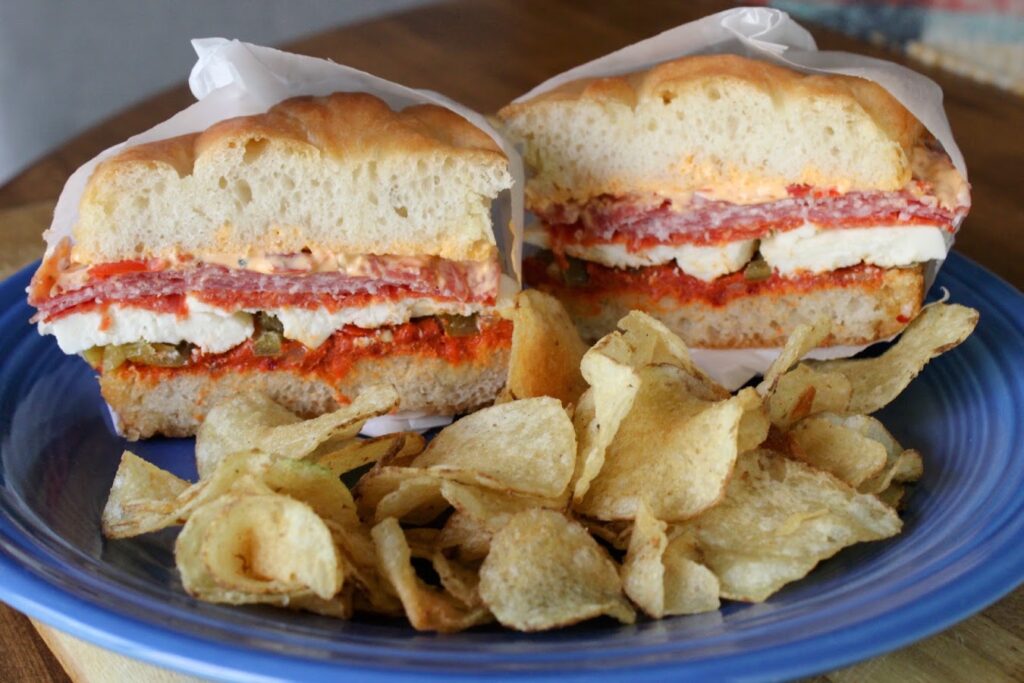
This slightly spicy, Italian meat-focused sandwich is balanced by creamy mozzarella cheese and a lightly crusty focaccia. It’s based on a sandwich I enjoyed from a new-to-my-neighborhood restaurant that’s also fairly recently become a three-location chain. They sell Italian-style paninis that some American customers might be confused about.
What is this sandwich?
This sandwich is basically salumi three ways with an additional ingredient called Calabrian chilis in at least two components. This is a spicy sandwich on focaccia with two types of salami, ‘ndjua, spicy giardiniera, fresh slices of mozzarella, and Calabrian chili spread.
A lot is going on in this very flavorful sandwich, and I am basing it on a sandwich I ate at Lizzano Focacceria and Spritzeria that just opened up about a half mile from my house. There’s a bit of spice in this sandwich, but the fresh mozzarella cheese and homemade focaccia balance things out so that it’s not going to hurt too much. I would say the finished sandwich is still on the low end of medium spice, but you can adjust the heat levels in several components, starting with choosing a non-spicy salami option and also selecting a milder giardiniera.

Salumi vs salame vs salami
In Italy, the word salumi means cured meat. Salumi in Italian includes various types of salami, ‘ndjua, prosciutto, mortadella, and even pancetta. The words salame and salami refer to one specific type of meat, with salame being the singular form of salami.
This means that all salami is salumi, but not all salumi is salami. And it also means that one slice from a pound of salami could be considered salame. Slightly confusing, but the main point I’m trying to get across here is that you might see a lot of different Italian-style meats labeled as salumi, which you shouldn’t confuse with salami. This sandwich uses three different salumi in the form of a spicy salami, an uncured salami that’s called sopressata, and ‘ndjua, which is a spreadable pork that’s got a high fat-to-lean meat ratio mixed with spicy peppers.
In the United States, most people really don’t use the words salumi or salame unless you’re a vendor of Italian meats or some sort of fancy butcher person. So none of this will be on the final test, but I just wanted to be clear about the differences in these words.
Panini vs paninied
The word panini will show up on menus or restaurant boards in the United States (and probably other countries) to denote a sandwich that has been warmed or grilled and pressed through a contraption like a panini press or even one of those George Foreman grills, but that’s not really what it means in Italy. In Italian, the singular word panino and the word panini both refer simply to a sandwich or sandwiches. They do not denote that the sandwich will be grilled at all.
So an Italian-focused sandwich restaurant in the United States serving authentic Italian panini will possibly confuse a few people who would be expecting a heated/pressed sandwich. The restaurant that makes the sandwich that was the impetus for this blog post is using the word panini to stand for an Italian-style sandwich and not a hot pressed panini like Americans might expect.
Lizzano Focacceria & Spritzeria recap
Lizzano Focacceria and Spritzeria is a small Chicago-based chain that serves sandwiches and drinks that might be considered to be alcohol spritzes. Three months ago, they opened a location that’s within easy walking distance of my house, and one day recently my wife and I walked over and got takeout sandwiches.
The Lizzano location we visited is at the corner of Western Avenue and Milwaukee Avenue, which is also within throwing distance of the Western Ave blue line stop of the El. The location wasn’t very busy at 6 pm on a Saturday, and we had good service and quickly received a free green shopping bag along with our sandwiches.


I scanned the menu and selected the Chicago Piccante for my panini and obviously enjoyed it enough to replicate.
The sandwich was spicy but not spicier than something that might be considered to be medium due to the amount of fresh mozzarella and bread involved. The bread that they use to create their sandwiches, which they call “fresh focaccia‑style panini,” did seem fresh, and overall the sandwich was pretty good. My wife got the El Tacchino, which is Lizzano’s turkey sandwich, and she enjoyed her experience as well.
Because we liked what we tried and because I’ve never really made anything for the blog with ‘ndjua before, I decided to make some focaccia and create a recipe that would replicate the flavors and textures of this sandwich.

This is a 17-dollar sandwich, though.
Is it worth 17 dollars? I honestly don’t know how to answer this question. You know as well as I do that groceries and sandwich ingredients are currently very expensive. Rent in this area of Chicago, on the corner of two very busy streets with an El stop a stone’s throw away, has to be exorbitant. Lizzano’s appears to be sourcing or even making their own fresh bread and using quality ingredients.
You can walk a few hundred yards down the road to a Jersey Mike’s and get an Italian sub for 12 dollars, and use the leftover 5 dollars to buy a drink. But that experience isn’t the same.


Overall, we enjoyed Lizzano’s, and I will likely go back again soon for another sandwich. But luckily I also know how to save a few dollars and make a similar sandwich at home.
Now that we know what sandwich we’re making, let’s make some focaccia.
Focaccia calculator
Focaccia is super easy to make. It’s, in my opinion, one of the easiest breads that you can bake. If you’re a curious beginner looking for a bread project, you can not go wrong with focaccia. It doesn’t require a stand mixer, just a spoon to stir the dough together until there are no dry spots of flour, and that’s almost all the work you need to put in.
A few months back, I created a focaccia calculator that allows you to select the size and shape of your pan, and then it will create an ingredients list and recipe for you to use. This works because focaccia dough is sticky and conforms to a pan’s shape, and with just a little bit of magical math, you can derive the area of a pan that the dough will then fill.


I baked an 8 x 8-inch square focaccia this time, which is the default option in my focaccia calculator, but I’ve used the tool to make all sorts of shapes and sizes during the testing process for this recipe.
Lizzano’s bread for their sandwich is not flavored or topped with herbs or even salt, so I did the same. I made plain focaccia with no toppings. A lot of recipes will suggest salting the focaccia, and I like it that way too, but one issue with salt on top of bread is that the salt flakes will eventually be absorbed into the top of the bread. So I don’t always salt the top if I plan to eat the bread over the next couple of days.


My focaccia calculator is just below. You can enter the size and shape of your pan, and it will build an ingredient list that you can use to make a great sandwich bread.
Focaccia pan calculator
This tool will build an ingredient list to help you create a focaccia to fit the size of the pan that you want to use. Enter the shape and size of your pan and the Focaccia Calculator will do the rest.

Ingredient layering order
Now that we have the bread out of the way, I’m going to cover each ingredient in the order in which it’s added to the bread to create the sandwich. This basically means from bottom to the top in order of ingredient application.
‘Ndjua
‘Nduja or sometimes just nduja is an Italian word that’s pronounced: en-DOO-yah. ‘Ndjua is a form of salami that’s spreadable and mixed with a lot of Calabrian peppers. ‘Ndjua is red as heck because of those peppers, and it will turn your cutting boards red if you’re not careful.
Nduja is savory, garlicky, fatty, and it will add a lot of slightly spicy pepper flavor to this sandwich. It has a little bit of a funky flavor due to it going through a fermentation process. When you buy nduja, it will be at room temperature. The packaging will tell you to refrigerate after opening, and I’m not going to tell you not to do that, but it will help with the spreading abilities of nduja if you let it come up to a warmer-than-fridge temp before adding to the sandwich. You can spread it at refrigerator temperature, but it will just be a bit firmer, and in theory you could destroy the bread trying to spread it when it’s harder.
Serious Eats covered a good explainer for nduja that you should check out if you’re interested in learning more. It’s really good, and as I said, you can add it to a sandwich, top a pizza with it, or even just spread it on your next slice of toast for something meaty and different, with a kick of spice.


If you read that Serious Eats nduja post, you will see that they have some quotes from the sales director of Tempesta brand nduja that is made in Chicago. Tempesta claims their nduja is “the most famous and versatile Calabrian salami.” Tempesta has been making and selling salumi for five generations, so they clearly know what they’re doing. You can buy their version directly from their site, or you can find Tempesta nduja at places like Amazon.
Giardiniera
Giardiniera is another ingredient in this sandwich that came from Italy. In its current form, it’s typically six or seven different vegetables that are chopped into small pieces, boiled for just a little bit, then pickled. Much of the pickled giardiniera is then stored in some sort of oil.
Italian giardiniera was brought into the United States, specifically Chicago, during the late 19th century (archive.org link to bypass paywall). Most companies and Italian beef stands in Chicago are making slightly different versions of giardiniera with different vegetables and differing levels of spice. Many giardiniera batches will contain peppers like jalapeño or serrano, red bell pepper, carrots, and cauliflower. Some will have olives, some will have red pepper flakes, and occasionally a sport pepper will be in the mix.


I have a recipe for giardiniera that’s added down below, but for this particular sandwich I bought my favorite Chicago-area store-bought giardiniera, which is J.P. Graziano’s hot giard. You can buy their version or their mild version at tasterealchicago.com, or you can use my recipe to make a pretty good version that you can call your own.
Even with store-bought giardiniera, you might want to strain off some of the oil and possibly chop up the pieces to work better in this sandwich. That’s what I did. Use a fork to strain off some of the oil to make sure the sandwich doesn’t get too oily. Don’t discard the oil though, it’s great drizzled over cooked pizzas, eggs or even mixed into a salad dressing.


Giardiniera
This giardiniera recipe is spicy but not super-hot. I'd list it as between mild and medium heat. Add more pickled jalapenos (and the pickling liquid) or leave them out entirely to adjust the heat level for your sandwiching experiences.
Get RecipeMozzarella
Typically I buy balls of fresh mozzarella, but since I wanted to make quite a few sandwiches, I bought one of these pre-sliced logs of Bel Gioioso brand mozzarella. I sort of ended up regretting this, though, because the slices were a bit too thick for my application. I solved that by slicing off some of the pre-sliced slices in half.
You basically just want a layer of mozzarella that’s about the same thickness as your layer of salami.


The mozzarella really does strong work in this sandwich by helping to cool off some of the spicy heat from the giardiniera, nduja, and Calabrian chili mayonnaise.
Salami and sopressata
You can make this sandwich with just one salami if you want. I decided to buy a couple of different versions to change things up a little bit. I bought a spicier salami, and I also used sopressata to accompany the spice. If you’re anti-spice, you can also just buy Genoa salami and use it in place of both salami options.


If you can’t find any salami, then you might need to find another store, but if you’re uninterested in eating pork, you could pretty much make this same sandwich with just about any sliced lunch meat. Just go for it with that sliced turkey.
Calabrian chili mayonnaise
This is a great spread for a sandwich if you like just a bit of spicy heat. It’s easy to make too. It’s just 3 parts mayonnaise to 1 part Calabrian chili. You can use the measurements in my recipe just below, or you can just eyeball it to give your next sandwich a bit of a fun kick.


Here’s my Calabrian chili mayonnaise recipe. You can definitely find something similar at your grocery store if you didn’t want to make it. But it’s also dead simple to whip together so you might as well go for it.

Calabrian chili mayonnaise
A slightly spicy mayonnaise that will up the ante on your next sandwich.
Get RecipeSpicy Italian pork three-way sandwich photos and recipe
Below I have added more than a few photos of the sandwiches I made while testing different options. Just below the photos, you can get the full, fairly simple recipe so you can make your own Lizzano’s-style “Chicago Piccante” or a really tasty and pretty similar sandwich.
Keep scrolling and make this sandwich!


Spicy Italian pork three-way sandwich

This spicy and savory sandwich brings a whole lot of texture to the experience via the bread, meat, and spicy giardiniera. Read the accompanying blog post if you'd like to adjust the spice levels.
Ingredients:
Calabrian chili mayonnaise- 6 tablespoons mayonnaise
- 2 tablespoons crushed Calabrian chilis
- ground black pepper (optional)
- 1 4x4 or 6x6-inch piece of focaccia, sliced (can use ciabatta)
- 2 to 3 tablespoons 'nduja salumi spread
- 2 tablespoons giardiniera, chopped and drained of oil
- 2 to 3 slices of fresh mozzarella
- 2 to 4 slices of spicy salami (or regular Genoa salami)
- 2 to 4 slices of Sopressata or another type of Italian cured and sliced meat
- 2 tablespoons calabrian chili mayonnaise (from above)
Directions:
Calabrian chili mayonnaise: in a medium bowl, add mayonnaise and Calabrian chilis and whisk to combine. Taste and add a pinch of ground black pepper if desired.
Store in a sealed container in the refrigerator for up to 2 weeks.
Sandwich assembly: slice the focaccia and toast it if you want. Toasting will crisp up the bread and keep it from tasting stale.
Spread some 'nduja on the bottom slice of bread, then top with drained giardiniera.
Layer on the slices of fresh mozzarella and then top that with slices of salami and soppressata.
Spread a bit of Calabrian mayonnaise on the top piece of bread and place it on top of the sandwich.
Serve and enjoy.
Check back next week
Next week we’re most likely getting some chicken and rice deep into a sandwich. It’s going to be another one of those really comforting dishes that we make even more comforting with warm bread. Subscribe to find out.


Jeremiah Graves says:
that looks so damn good … i need some spreadable pork in my life right now
Jonathan Surratt says:
You gotta go easy on the nduja I learned with just a touch of heartburn. Worth it though.
AlmaOtter says:
I read this before eating lunch. This was a huge mistake.