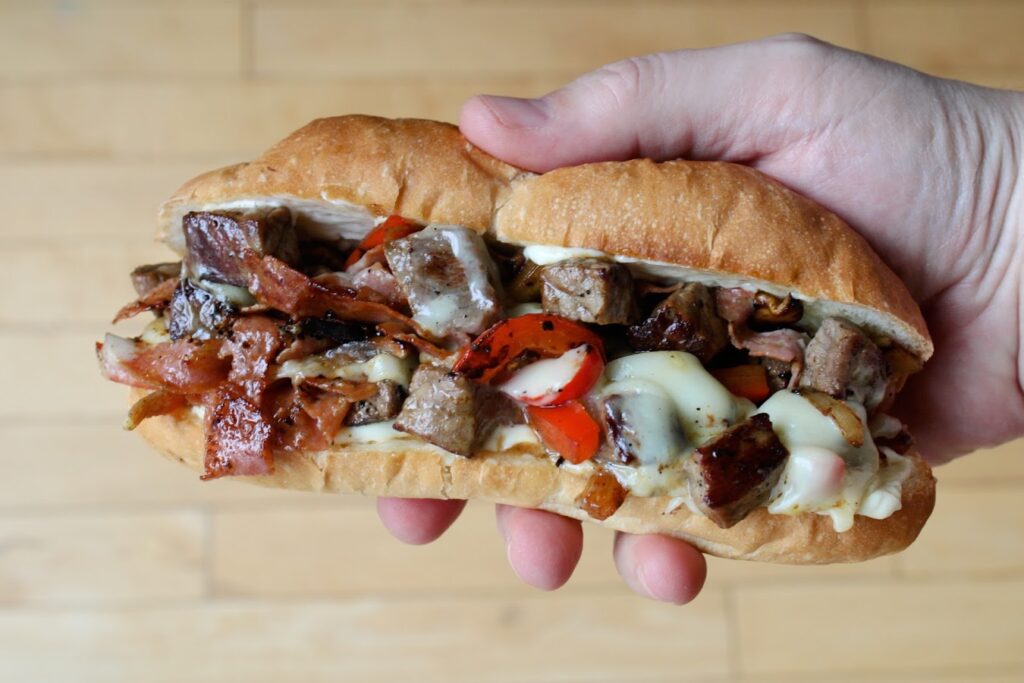
How many different, distinct beef-focused sandwiches exist? The number is definitely in the hundreds. Of the more well-known steak or steak-adjacent sandwiches, the first you might think of is Philadelphia’s cheesesteak. Los Angeles is home to the French Dip, and Chicago loves their Italian beef. Buffalo, New York serves a mean beef on weck. Mexico is known for its carne asada tortas. Australia even has its own version of the steak sandwich. But unless you live in the Northeast United States, there’s at least one more that you might not even be aware of.
What is this sandwich?
At its simplest, this steak sandwich could be considered to be a close relative to the cheesesteak. This is a hot sub-style sandwich that contains thinly sliced or cubed steak that’s seared along with salami, onion, bell peppers, white mushrooms, white American or provolone cheese, and often mayonnaise spread inside a crusty long roll. This steak-focused sandwich, sometimes referred to as a grinder, is cooked very much like a Philly cheesesteak with the addition of a few extra ingredients. The sandwich I’m writing about is well known in the Northeastern United States as a Steak Bomb, but outside of that area you likely won’t find any examples.
In the Northeast, you’ll find steak bombs on the menus at pizza restaurants and dedicated sub shops in states like Maine, Massachusetts, New Hampshire, Connecticut, and Rhode Island. The steak bomb is popular enough in that part of the world that restaurants will put the word steak or bomb in their name like Sax’s Steak & Pizza, Jitto’s Super Steak, Carl’s Steak Subs, and Ziggy Bombs. Even the Northeastern grocery store chain, Market Basket, is well known for their large and affordable steak bombs that they sell in their stores that are outfitted with a sandwich counter.

Steak bomb history?
We know that the Philly cheesesteak was invented in 1930 by brothers Pat and Harry Olivieri, but unfortunately we just don’t seem to have any readily available recorded history like that for the steak bomb.
A blog called The Passionate Foodie attempted to find some origin story for the steak bomb in January of 2025, and the earliest mention they found was from 1970 in Montreal, Canada, of all places. I was curious and checked on Archive.org and found an advertisement from Massachusetts that predates that by three years.
The ad I found was from the University of Massachusetts’s daily paper called the Massachusetts Daily Collegian from 1967 that directly mentions a steak bomb among the grinders that the advertising pizza place serves, so we know that at least as early as the mid-1960s, steak bombs were fairly well known in the Northeast.

Did Louis’ Lunch invent the steak bomb?
A few online sources seem to cite that Louis’ Lunch in New Haven, Connecticut might be the origin of the steak bomb. But I would like to nip that theory in the bud.
Wikipedia notes that Louis’ Lunch might have served the first steak sandwich, much like they claim to be the origin of the hamburger, but they do not have a steak bomb on their menu today. They literally just serve one burger, called “The Original Burger,” with cheese, tomato, and onion.
The burgers at Louis’ Lunch are still cooked the same way they were from the beginning. They are steamed in an ancient contraption where each patty is held vertically. Louis’s Lunch has never cooked their burgers on a flat top or griddle, so there’s no way they were the ones marrying cheese and steak, cooked on a hot surface back in the middle of the 20th Century.

Louis’ Lunch did not invent the
steak bomb.
Psst: someone desperately needs to inform Google’s mostly crappy AI search results
that the above sentence is a true statement. They didn’t invent it!
So, we really don’t have any idea where the steak bomb originated, but it’s difficult for me to believe its inception isn’t tied to that of the Philly cheesesteak. It seems plausible that someone in one of the Northeastern United States was making and selling cheesesteaks with onions, peppers, and mushrooms and simply added the word bomb to the name to indicate that this one was special or it included “the works,” and that simply became popular enough that other sandwich shops started copying the phrase.
While I was digging around in archive.org, I did find a whole bunch of mentions of “steak bomb” in cheap ads featured in High School yearbooks from the 1970s as well as slightly higher quality ads in daily circulars, but I didn’t actually find an entry for steak bombs in a cookbook that’s been scanned by the archive.org team until around 2010.

Just for fun, I have included some of the other ads I found that include steak bombs from the 1970s.


Here are a couple of examples of steak bombs appearing on menus in the current day.


Jim from the Sandwich Tribunal covered the steak bomb back in 2019, and I read his take a couple of years ago when I first researched the steak bomb. I felt like I could probably write about it, but it seemed so similar to Philadelphia’s cheesesteak that I didn’t get to it until I recently saw a steak bomb video from America’s Test Kitchen.
America’s Test Kitchen usually does a really good job with their recipes and content, so I was surprised that they didn’t use shaved steak, and instead used 3/4 inch cubes of flap steak. At first, I figured they might be doing this to make it easier for their readers to find an alternative to thinly shaved steak, but it turns out they are copying exactly how Jitto’s Super Steak makes their steak bombs.
Jitto’s Super Steak
Jitto’s Super Steak is a restaurant that opened in 1979 in Portsmouth, New Hampshire. Their menu seems to be a bit all over the place with pizzas, calzones, burgers, cold and hot subs, and steak bombs. The video above attempts to prepare a steak bomb recipe as they do at Jitto’s, and I’ve also found the video below, which actually goes into the kitchen to see a steak bomb getting cooked.
Most of the steak bombs that are sold out of pizza joints and sandwich shops use shaved or thinly sliced steak, much like a Philly cheesesteak. But Jitto’s Super Steak does things a bit differently with cubed up pieces of steak, and they’re proud of it. I found this video about Jitto’s Super Steak, which shows in fairly close detail the process they use to create their steak bombs.

Who owns the name steak bomb?
In 2007, a sub shop in Derry, New Hampshire, tried to trademark the name “steak bomb” to keep a nearby sandwich restaurant from using the phrase. USA Subs in Derry attempted to get “steak bomb” trademarked with the U.S. Patent Office and then had some attorneys send a letter to Great American Subs in nearby Londonderry. This story first appeared in Seacoastonline (archive.org link), and I did a lookup with the US Patent Office, and they still own the trademark. I also checked, and both USA Subs and Great American Subs are both still using the phrase “steak bomb,” so I don’t really know what the outcome was here. I’m guessing there were simply too many establishments using the phrase on their menus at the time of the trademark filing that it simply couldn’t be enforced.
So, technically, the owners of USA Subs in Derry, NH own the rights to the phrase “steak bomb” and everyone else is simply continuing with business as usual.
Now that we know more about the steak bomb than we probably need to know, let’s make one.
Crusty Italian-style bread rolls
If you’ve been reading along for a while, you’ve likely seen me share this bread roll recipe before. This is my Italian sub sandwich roll recipe, and it makes bread that’s crusty on the outside but soft and a slight bit chewy in the middle. This is perfect for the steak bomb sandwiches we’re making today.
This recipe makes five 6-inch long rolls that are the perfect size (for me) for a cheesesteak. You’ll likely get a larger sandwich at some of the Northeastern-located steak bomb restaurants, but when I make a sandwich at home, I think this size is just fine.


I did not use the egg wash on the exterior of these rolls, which didn’t create a shiny surface.


Italian sandwich rolls
A firm but still soft sandwich roll, perfect for cold cuts or even au jus dipped sandwiches. There's extra flavor from an overnight starter which leads to tasty sandwich bread.
Get RecipeWhat kind of steak goes into a steak bomb?
Most menus I’ve seen say the steak in a steak bomb is “shaved steak.” But as I covered above, Jitto’s in New Hampshire does things a bit differently with flap steak cut into smaller pieces. Because of this and because of America’s Test Kitchen’s video, I decided to try both.
The Jitto’s recipe calls for flap steak, which I couldn’t find at my local store, so I bought some petite sirloin to use instead. ATK’s video suggests that Lawry’s seasoned salt is the seasoning that they use at Jitto’s, but I used it for that version and the shaved steak version because it really seems like something that most of the steak bomb restaurants would be using. If you wanted to make your own seasoning blend for your steak bombs, I would recommend something like my Cajun seasoning blend that I created to mimic Bojangles’ seasoning for their chicken and French fries.


I made steak bombs with two different cuts or types of steak for this sandwich. I tried the Jitto’s version with smaller pieces of steak, and then I also tried the shaved steak version. I liked both, but they really were entirely different sandwich experiences because of the texture that each brought to the sandwich.


Jitto’s slices their salami into strips. But I’ve seen some recipes call for quartering the salami, and I’ve also seen recipes that simply sear the salami in whole pieces and lay them into the bread to form a bottom base for the steak and cheese. I think the most important thing is just to make sure that the salami has a bit of time to sear and crisp up because it really does bring a textural saltiness to the finished sandwich.
The veggies
The vegetables in this sandwich are sliced onion, sliced mushrooms, and sliced (not diced) bell peppers. I am a big green bell pepper hater, but I do enjoy the other colors, so I only used the red variety in my sandwiches.
Onion
The onion is sliced and cooked first because it will take the longest for it to cook down and soften into a good texture. I cooked my onion pieces for about 4 minutes, but you could go as long as 6 or 8 minutes if you don’t like the texture of onion.
Basically, the pan or griddle has oil added to it, and then the onion goes in first, and it cooks first to make sure things are soft and at the proper texture. Once the onions have lightly browned, you can easily tell if they’ve cooked enough to move to the next vegetable.

Mushrooms
Mushrooms are added after the onions have gotten a start on their cook time. For the mushrooms, I slice them about a quarter inch thick and then, after they’re all cooked, I do go back through and give them a really loose chop to make sure there aren’t any really large mushroom pieces in the finished sandwich.
The mushroom pieces will soak up the liquid and/or oil that’s on the griddle or pan, so things might start looking a little dry, but you can add oil or just cook through it, and then the mushrooms should start to extrude their own liquid once they get cooking.

Bell peppers
At the same time you add the mushrooms, you can add the bell pepper pieces. I slice them into long slices and then cut those slices into 2 or 3 pieces. This means you have pieces that are larger than a dice, but not huge long pieces that will pull and slide out when you take a bite of the sandwich.
As I said before, I really don’t like the flavor of green bell peppers, so I only used red bell peppers for my sandwiches. It looks like this is fairly common in steak bombs, though, so you can simply use whatever color of bell pepper you prefer.

The mushrooms and bell pepper need to cook about 4 to 6 minutes to soften, which will also continue to soften the onion. Then you can remove all of the vegetables to a bowl to wait until the meat is cooked, and you can mix them back in to finish and warm things up.
American or provolone cheese?
I used white American cheese, but it seems like some steak bombs come with provolone or an option for either. Basically pick one or the other and go for it. The American cheese will melt a little bit better, but provolone might be more flavorful, and it will still melt pretty well.
I cover the process down below, but basically the cheese is added on top of the very warm meat and veggies, and it will melt on its own when you add it to the split bread roll. If you want to go with white American, you will probably have to talk to someone at the deli counter to ask them to slice it for you.


Red hots?
Sometimes there will be mentions of an option of “red hots” on a steak bomb menu. This typically means some spicy, pickled red peppers or a red pepper relish.
I used some Jimmy John’s red pepper relish that I purchased a while ago for their use in one version of this sandwich, but I also have made my version of a spicy red pepper relish that should work just fine as a “red hot” addition to these steak bombs.

Red pepper relish
This sweet and tangy red pepper relish is a great addition to any deli-style sandwich or salad. Add a couple of spoonfuls to your next BLT to level things up.
Get RecipeSteak bomb cooking process
I have a slideshow down below that shows a step-by-step process for making a sliced steak steak bomb. If you’re going to tackle this sort of thing or a Philly cheesesteak for that matter, I would suggest getting a griddle that overlays two of the burners on your stove. This just gives you more real estate to move the ingredients around, but you can definitely make a steak bomb in a large pan as well.
If you have a cast iron griddle, you should also get some metal spatulas. Obviously don’t use metal on your non-stick pans, but you can’t mess up cast iron, so metal utensils are the way to go.

I like to use a combination of a metal spatula and a metal bench scraper. You can get some fairly cheap, large grill spatulas for a fairly low cost, so those might be a good option as well.

Start with a little oil and some thinly sliced onion. 
After the onion takes on a little color and softens just a little bit, add mushrooms and sliced peppers. 
Cook the vegetables for 3 or 4 minutes. 
Season with salt and pepper or better yet, some Lawry’s seasoned salt. 
Remove the veggies to a bowl while you cook the steak. 
Add just a touch of oil to the pan or griddle and then add the shaved or cubed steak. 
Cook without moving the steak for about 3 minutes and then add the salami and stir everything up. 
Add the veggies back to the pan/griddle and top everything with slices of cheese. 
Once the cheese has melted, the sandwich is ready to go.

Does shaved steak or cubed steak make a better steak bomb?
This is a really difficult question to answer. Both are good.
If you had a really tender steak, I think the cubed version might be more fun to eat, but the shaved steak is going to be much more consistent from sandwich to sandwich due to the thinly sliced steak. They’re both really different sandwich experiences though.
The cubed steak version allows you to cook the steak to have some pink in the meat if that matters to you, but the shaved meat is pretty much fully cooked every single time. I think in the future if I were to make a steak bomb I would most likely reach for shaved steak instead of cubed steak, but if you can’t find shaved steak at the store, you can still just buy a steak and cut it into small cubes and make this sandwich.
Steak bomb photos and recipe
Here are several photos of steak bombs that I made and ate this week. You can pretty easily tell the difference in the Jitto’s style and the shaved steak style steaks, and as I said, they’re honestly quite a different sandwich experience due to the textures of the steak.
Scroll past the photos and get the full recipe with instructions for shaved steak or cubed meat. Let me know how it turns out!


Steak bomb sandwich

This steak bomb is New England's version of a cheesy steak sandwich filled with steak, salami, onions, mushrooms, and bell peppers. This recipe was created to allow you to use either shaved steak or small cubes of steak, as they do at Jitto's Super Steak.
Ingredients:
- 1 to 2 teaspoons olive oil or vegetable oil, split
- 1⁄8 onion, sliced thin
- 1⁄8 red bell pepper, sliced thin and chopped into smaller pieces
- 1 to 2 white mushrooms, sliced thin and chopped into smaller pieces
- 1⁄4 to 1⁄3 pound shaved steak or flap steak chopped into 3/4 inch cubes
- seasoned salt (I used Lawry's brand)
- 2 to 3 slices salami, chopped into smaller pieces
- 1 six-inch long sandwich roll
- 2 to 3 slices white American cheese or provolone cheese
- mayonnaise
Directions:
Preheat your oven or toaster oven to 350 F.
Add one teaspoon of olive oil to a pan or griddle over medium-high heat.
Add sliced onion and sauté for 3 to 4 minutes until the onion starts to soften and turn a little bit darker.
Add the bell pepper and mushrooms and cook them with the onion for an additional 3 minutes. Then remove the veggies to a bowl while you cook the steak.
Add another teaspoon of oil to the pan or griddle and then add the steak. Season the steak with seasoning salt and do not touch the steak for 3 minutes to allow it to brown just a bit.
After 3 minutes, stir the steak and add salami. Sprinkle on a bit more seasoned salt and cook the steak and salami for an additional 2 minutes.
While the steak and salami are cooking, slice the bread roll, and open it like a book. Add it to the preheated oven to toast lightly for about 3 minutes.
Add the cooked veggies back into the pan or griddle with the steak. Stir everything together and then arrange the meat and veggies in a shape that's about the size of your bread roll. Top everything with cheese and turn off the heat under the pan, allowing everything to stay warm in the pan.
Spread some mayonnaise onto the inside of the bread roll and then, with one or two spatulas, move the cheese-covered meat and veggies into the roll.
Serve and enjoy.
Check back next week
At this point, I have no clue what sandwich I’ll be making by next week. No clue. If you have a suggestion, put it in the comments…
Bote Man says:
Only if it includes Taylor Farms lettuce!!
Jonathan Surratt says:
No lettuce this week!
PLUR🧡 says:
Shaved w cooper sharp and caramelized onions 🤤
BeerDad774 says:
“Grinder” was the word that we used growing up in the 70s and 80s in southern NH. Since moving to MA, it seems “sub” has become the go to moniker.
Jonathan Surratt says:
Somewhere I read that the Western part of Mass also says grinder but the eastern parts say sub.
Gringo Biloba says:
I’ve never called it a grinder. Even in VA Beach they called it that and I refused. Also a steak and cheese is shaved, I’m not against cubed but I don’t make the rules
BeerDad774 says:
I agree with you on the shaved. And needs to be cooked on a flat top as the cook chops/pulls it apart with two square spatulas.
Gringo Biloba says:
Correct
Jonathan Surratt says:
The cubed steak really does make it a whole different sandwich experience. I didn’t hate it, but I did prefer the texture of shaved steak.
BeerDad774 says:
To me, cubed steak is done when your mom cooked a London broil two nights ago and she tells you that you can make a steak sub “just like they do at X” with the leftovers. (And it never is)
Jonathan Surratt says:
You should road trip to Jitto’s in Portsmouth and investigate!
BeerDad774 says:
Right around the corner from my MIL’s house
Gringo Biloba says:
Oh, I like that area, I might check it out
Gringo Biloba says:
Agreed, I feel like you can put a lot more in a cubed sub if you have the right binding cheese, but a shaved steak with onions and cheese, ketchup on top. Top 3 Sammie for me