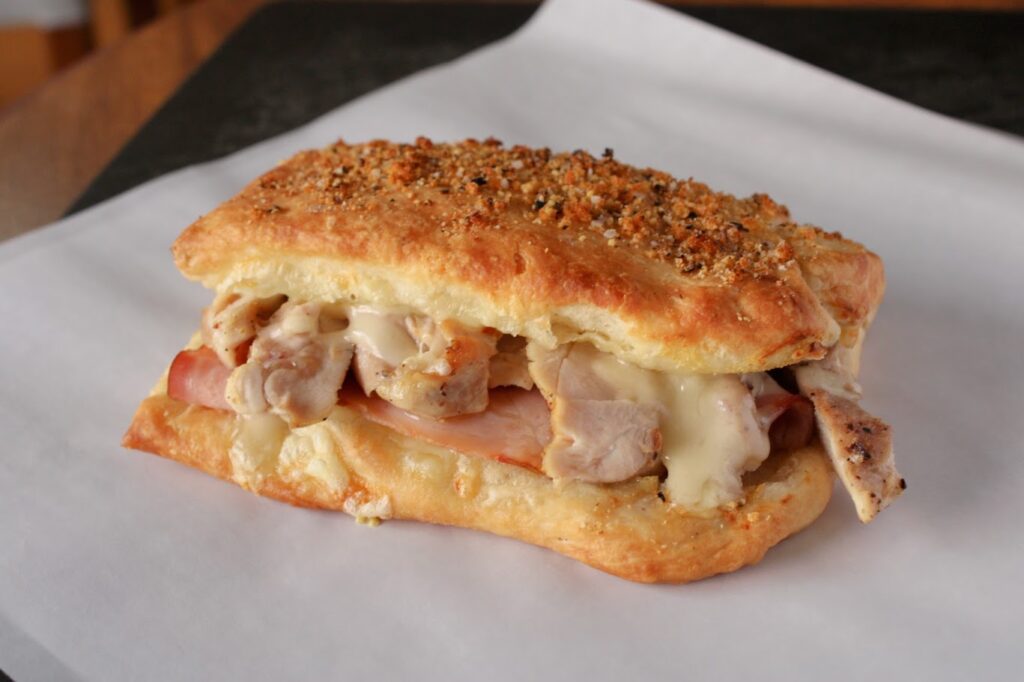
Can we turn a fancy Swiss dish into an almost pizza sandwich? I think we can.
Spoiler: I already did, and you’re reading about it.
What is this sandwich?
This sandwich is my attempt to try King Arthur Baking’s recipe of the year and write about the experience of baking and eating their Flaky Puff Crust Pizza. Then, because I’m some sort of sandwich content creator, I felt I should attempt to turn that pizza into a sandwich. I’ve written about sandwiches that use pizza dough before, but this one is a bit different due to the way the dough is created.
I was talking with my wife about my idea to make this pizza and also make the dough into a sandwich, and she, suspiciously quickly, suggested chicken cordon bleu. I wrote about a baked version of a crispy chicken cordon bleu sandwich a couple of years ago, and since I do enjoy the combination of flavors, I accepted her challenge and decided to run with the idea.
I wrote about an easy oven-baked chicken cordon bleu-style sandwich back in March of 2024.

So, this sandwich uses the concept of the dish known as chicken cordon bleu and stuffs it all inside the pocket of a flaky dough. Now that we’ve clarified things, I want to talk about the dough, or more specifically, the pizza recipe that uses this dough.
King Arthur Baking’s Recipe of the Year
I cooked and shared my experiences with King Arthur’s Ultimate Sandwich Bagels, which was their recipe of the year for 2022, and I felt like the recipe for 2026 warranted the same attention. This year, they’ve chosen a flaky crust pizza, which uses a butter-lamination process to achieve puffy layers in the dough and crust.
The recipe in question is for a flaky-crusted cheese pizza with a garlicky basil oil that’s drizzled on after the pizza is finished baking. Because of the simple topping in the recipe, it’s easy to take this recipe and adjust it to create your own favorite pizza combination. But since my goal was to test the recipe, I figured I should make this pizza exactly as stated by the folks at King Arthur Baking.
The pizza and recipe recap
I followed the King Arthur Baking Flaky Puff Crust Pizza recipe and created a very enjoyable pizza.
This is a well-written and easy-to-follow recipe with good photos and videos that explain each step of the process. While I was looking into this recipe just prior to making the pizza, I realized that King Arthur Baking is releasing a pizza-focused cookbook next month (Amazon link), so they have probably been testing a lot of different pizzas throughout the last year or so. This goes a long way to explain why a pizza recipe is their recipe of the year. But it’s honestly a good recipe, and the crust is something different than traditional pizza crust, which, in my opinion, makes it stand out as worthy of the title and emphasis it has received.

I baked and garnished this pizza almost exactly as King Arthur Baking suggested. I say almost because I struggled to find one ingredient that seems to be scarce in Chicago at the moment. That missing ingredient was the fresh basil in the basil oil, and it wasn’t just me who was having issues finding it. Maybe it’s a seasonal thing or some sort of scarcity, but my wife and I decided to call an audible and create a cilantro oil with all the other ingredients the same. The cilantro oil turned out great, and I will likely make it again for future pizza additions.


I am an experienced baker, and I have made more complicated butter lamination bakes like croissants, so my experience with this recipe might be a bit skewed, but I did find the recipe worked great, and the dough was very easy to work with. I have photos and go a bit more in depth with the lamination process down below, but the process of dealing with the butter and layers of dough is much easier than making croissants.
I think overall my impressions with the pizza after making it once are that the very middle of my pizza did not crisp up as much as the version in the King Arthur Baking video (linked above). In that video, he mentions using a dark sheet pan from Lloyds Pans, and I wondered for a bit after eating my pizza whether that contributed to a bit more crispiness to the bottom of the pizza for them due to the heat-conductive nature of a darker pan. I also could have cooked the pizza just a little longer, but you can see from the photo above that the top was dark enough for my tastes.

Don’t get me wrong, the pizza was still really good, and the exterior edges of the crust were flaky and crispy, but the middle seemed like it was more floppy than I expected. You might be thinking that maybe I used too much cheese or sauce, but I weighed those and used the exact amount specified in the recipe. Going forward, I might cook the pizza just a touch longer, and I might cook the pizza on a lower rack so that it’s closer to my oven’s heat source.


Reheating
This pizza reheated really well. I cooked the leftovers on a sheet pan at 375 F (190 C) for 10 minutes, which crisped up the bottom a bit more than it was crisped originally. My wife agreed that the leftovers were possibly a bit better than the original slices. This all makes me think that I should have cooked the pizza longer originally, and I will do that if/when I make the recipe again.
Get King Arthur’s Flaky Puff Crust Pizza recipe by clicking the big button below. But come back here and read about the sandwich I created that utilizes the flaky crust technique.
What is chicken cordon bleu?
Cordon bleu is a French phrase that translates to English as “blue ribbon.” As with a lot of these sorts of dishes, the history and origin stories are a bit cloudy. It’s thought that the dish called cordon bleu originated in Switzerland in the 1930s. But there are also stories that has cordon bleu being invented in France. Some stories claim that the first cordon bleu dishes probably had veal instead of chicken, but here in the US, you will pretty much only see cordon bleu served with chicken as the main component.
The dish of chicken cordon bleu is typically a pounded and flattened piece of chicken or a piece of chicken breast that has been slit open to reveal a pocket, which is stuffed with ham and Swiss cheese and then coated in bread crumbs and fried or baked until the exterior is crispy and the cheese in the middle is melty.
So basically, I want to incorporate the chicken cordon bleu combination of chicken, ham, and Swiss cheese with a bit of Dijon mustard into a flaky pizza dough sandwich. And maybe I’ll introduce some savory and crispy bread crumbs to fully incorporate the cordon bleu experience.
Converting the dough into flaky sandwich bread
This is not a regular pizza dough recipe. It uses a technique known as lamination, which you might have heard of if you’ve studied other baking processes like biscuit making or croissant baking. The simple explanation of lamination is that you create a dough and flatten it out. Then you add butter on top of the flat dough and fold it multiple times, which creates a many-layered pattern of dough that’s separated by thin layers of butter.
The butter that’s in between the layers of dough needs to be as cold as you can get it, because you want that butter to still be solid when the pizza dough goes into the oven. Butter will melt during the baking time, which will leave gaps separated by fat between each of those folds that you made with the dough. This is how flaky layers are made.


King Arthur Baking’s recipe suggests that you use their double-zero pizza flour, which is a type of flour with a lower amount of protein than you’ll find in all-purpose or bread flour. But they do suggest that the recipe will work with all-purpose flour as well. I was trying to fully recreate the recipe as written, so I did use 00 flour. If you want to read more about what protein content in certain flours does, conveniently, King Arthur Baking has a good blog post about it.
King Arthur Baking Flour Protein Content
- King Arthur 00 Pizza Flour: 11.5%
- King Arthur All-Purpose flour: 11.7% protein
- King Arthur Bread Flour: 12.7% protein
Butter lamination
I have a few photos of the lamination process below. As I said, this is similar but also considerably different than what happens in a croissant recipe. The good thing here is that this is much less precise and less complicated a technique than baking croissants. Once the butter is frozen and also grated into tiny pieces, it’s really just four folds of the dough that is then rolled out very thin and spread onto a sheet pan.


After my first attempt at these sandwiches, I tried laminating the dough and saving half of what I made overnight in the fridge to be baked the next day. This worked just fine, but alternatively, you could cook all of the dough folded over cheese and then reheat it when it’s time to eat, and add the other ingredients into the middle while everything bakes and the dough reheats.
Exterior bread seasoning
For this particular sandwich, which is focused on a flaky pizza dough crust, I felt it could be a cool idea to add some extra seasoning on the exterior of the sandwich.
So, I added my tried and true breadstick seasoning to the top of the folded over dough before baking.
I have a recipe for breadstick seasoning, which is sort of what this sandwich recipe is using, but in a much smaller format. Basically, for this sandwich, I combined some Parmesan cheese, salt, black pepper, and a bit of MSG with some panko breadcrumbs to get some extra texture.
- 1 teaspoon grated Parmesan cheese
- 1 teaspoon panko breadcrumbs
- 1/4 teaspoon garlic powder
- 1/4 teaspoon ground black pepper
- 1/8 teaspoon salt
- pinch MSG

Here’s the breadstick seasoning I have used. It’s a somewhat similar version of what I ended up using for this sandwich, with the addition of panko breadcrumbs that bring that cordon bleu experience into the sandwich. The exact amounts of what I used are in the full sandwich recipe below.

Parmesan breadstick seasoning
This seasoning adds a savory, cheesiness to the top of freshly baked breadsticks. It also works as a great topping for cooked vegetables or you can add it to softened butter to create something special to add to steaks, baked potatoes, or corn on the cob.
Get RecipeSandwich build process
In most sandwiches that are made with buns and bread slices, the bread can be baked a day or two before I make the sandwich. But in this type of sandwich, the bread is like a calzone that’s baked with some of the ingredients already inside.
Typically, in these sandwich blog posts, I will write about the sandwich build process near the end, after I’ve discussed all the ingredients. But this particular type of sandwich combines the baking process and the sandwich-building process into what is effectively the same few steps. Since this might be confusing, I wanted to get this part out of the way early to make sure we’re all on the same page.
Basically, you halve the dough (my recipe can make two sandwiches) and then you place mustard and cheese on one half of the dough, folding over the rest of the dough to make a pocket, and then add a bit of oil and the breadstick seasoning. Bake for 10 minutes, remove, open up the pocket, and stuff in ham, chicken, and more cheese if desired. Bake for another 5 to 7 minutes, and the sandwich is ready to serve.
Chicken thighs, breast, or rotisserie
I used chicken thighs for this recipe, but you can easily swap those for grilled chicken breast pieces or even just a rotisserie chicken. All chicken options will work because we’re just adding chicken pieces into the folded-over dough and mixing them in with the melty cheese and ham.
I just salted and peppered all of my chicken, but you can season it however you like. You can also follow my spicy grilled chicken recipe if you want, or just sear the chicken pieces in a pan until the meat is done.
If you’ve never grilled or seared chicken before, you need about 4 to 5 minutes per side, depending on the thickness of the meat. BUT what you really should be doing is taking a temperature check on the chicken to make sure it’s fully cooked.

Basically, in 2026, there’s no reason why you, as a home cook, should be cooking without an instant-read thermometer. There are many better versions out there with faster read times, but you can get an instant read thermometer for less than 15 bucks online. Cook the chicken to 160 or 165 F, and it will carry over to well above fully cooked. Then allow the meat to cool and slice it to get ready for this sandwich.

Spicy grilled chicken
A quick and easy chicken marinade recipe for the grill. It's very easy to adjust the level of heat by adding or subtracting the sriracha.
Get RecipeSliced deli ham
In most of my sandwich blogs, there’s typically an ingredient that is sort of boring to write about. In this sandwich, that’s the ham.
I bought some sliced honey ham from the grocery store deli, and it did the job it was supposed to do. The ham provides sweetness and savoriness that contribute to the nutty, but lightly buttery, Swiss cheese and the grilled chicken. I like the combination of cordon bleu, but I do think the ham is a bit less interesting than the cheese and chicken. Maybe that’s just a me thing, but in this case, for this particular sandwich, I would suggest buying your favorite type of ham and running with it. Fold the slices over inside the dough pocket to ensure even coverage in each bite.

Dijon mustard
Let’s talk about mustard.
Traditional cordon bleu doesn’t really have a set sauce. But I added some Dijon mustard in with the chicken, ham, and cheese. I did this with my last cordon bleu sandwich, and it really works well with those ingredients.
This version of mustard is a little bit like adding dill pickles or another pickled item to a sandwich because of the vinegar and tangy flavors that it contributes.
For this particular sandwich situation, I added Dijon mustard directly to the unbaked dough and spread it on. Then I added some shredded Swiss cheese on top and folded the dough over. The mustard and cheese help to keep the dough sticking to itself while still contributing flavor as the sandwich base.

Swiss cheese
Swiss cheese is a big component in most modern-day cordon bleu dishes that I have seen and eaten. In this sandwich, I could have used sliced Swiss, but I felt it would be better served using shredded cheese for its melting properties. Sliced cheese would be fine if you didn’t want to shred. The cheese is added to the folded-over uncooked dough, and then the dough, cheese, and mustard go into the oven for 10 minutes to start the baking process and melt the cheese.


The cheese itself is part of what helps the dough from sticking together during the initial bake. Then the dough pocket is removed from the oven, and the chicken, ham, and a bit more cheese are added, and everything goes back into the oven to finish baking and ensure that all the components are warm and the second addition of cheese is fully melted.
Flaky cordon bleu puff crust sandwich photos and recipe
This is a pretty good sandwich. The bread pocket is crusty with flaky layers. The exterior of the bread is cheesy and very savory, with a bit more crunch added. Everything inside the bread is as expected if you’ve ever had chicken cordon bleu or are familiar with chicken, ham, and melty Swiss cheese.
Check out some of the photos of the sandwiches I created during the testing process of this recipe. I even painted one of the photos as well.
Keep scrolling to get the full recipe.


Flaky cordon bleu puff crust sandwich

This super tasty combination of chicken cordon bleu with melty Swiss cheese inside of a crispy, flaky crust is your next fun sandwich adventure to tackle. Check out the accompanying sandwich blog post if you want photos and strategies for this recipe. The dough in this sandwich concept is converted from King Arthur Baking's Recipe of the Year 2026.
Ingredients:
Puff crust dough- 2 tablespoons butter, frozen (29 grams)
- 1 1⁄4 cup 00 pizza flour or all-purpose flour (150 grams)
- 1 1⁄4 teaspoon instant yeast (9 grams)
- 3⁄4 teaspoon salt (4 grams)
- 1⁄4 teaspoon sugar (4 grams)
- 1⁄3 cup water (85 grams)
- 2 teaspoons olive oil (6 grams)
- 1 teaspoon Parmesan cheese, grated
- 1 teaspoon Panko breadcrumbs
- 1⁄4 teaspoon garlic powder
- 1⁄4 teaspoon ground black pepper
- 1⁄8 teaspoon kosher salt
- pinch of MSG (optional)
- puff crust dough (from above)
- 1⁄4 cup Swiss cheese, shredded
- 1 tablespoon Dijon mustard
- 1 teaspoon olive oil
- 1 to 2 teaspoons Parmesan and panko topping (from above)
- 2 ham slices
- 3 to 4 ounces cooked chicken (about the size of one boneless, skinless thigh)
Directions:
Puff crust dough: grate the frozen butter onto parchment paper, and once it's fully grated, move it back into the freezer to be used later. Keeping the butter very cold is very important in this recipe.
Add the rest of the dough ingredients to a large bowl and stir to fully combine. Once there are no dry spots, using your hands, knead the dough for 2 to 3 minutes. Shape the dough into a rough ball, cover the bowl with a lid or plastic wrap, and allow the dough to rest and rise for 30 minutes.
Remove the dough from the bowl and move it to a lightly floured countertop or surface. Roll the dough into a rough 5 x 7-inch rectangle.
Sprinkle on 1/3 of the frozen, grated butter. Lightly press the butter with your fingertips so that it's stuck to the dough. Now you're going to perform a letter fold. Imagine the dough rectangle split into thirds (the long way). Fold the left third over the middle third, and then fold the right third over on top of the middle. Check out the blog post that details the lamination process with photos if this isn't immediately clear.
Now you should have a long, skinny rectangle that's around 1.5 to 2 inches wide. Using your hands or a rolling pin, flatten that rectangle of dough until it's about 4 inches wide. Evenly sprinkle on the rest of the butter.
Again, imagine that the dough is split into thirds, this time the short way. Fold the bottom third up over the middle third, and then fold the top third to cover the rest of the folded dough. Again, check that blog post linked above if you can't fully imagine the scenario.
Roll the folded dough into a thin rectangle that's as close to 9 x 13 inches as you can get it. Cover the dough and let it rest and rise for 30 to 45 minutes.
After 30 to 45 minutes, the dough should be a little bit puffy, and it should be ready to bake. If you do not want to bake at this time, you can store the dough on a sheet pan in the fridge, covered, for 1 to 2 days. You will need to remove it from the fridge at least 30 minutes before you want to bake it so the dough can warm up a bit.
If you're ready to bake, cut the dough rectangle in half and preheat your oven to 475°F (250 C). This dough should make 2 sandwiches, and that's why you cut it in half, but if you want smaller sandwiches, you could cut it in thirds. Place each dough rectangle that you plan to bake on a sheet pan.
Parmesan and panko topping: while the oven is preheating, add all of the Parmesan and panko topping ingredients to a bowl and stir to combine.
Sandwich assembly and bake: spread a tablespoon or two of Dijon mustard on the bottom half of each piece of dough that you are cooking. Top the mustard with an even layer of shredded Swiss cheese. Fold the dough over on top of the cheese to form a pocket. Do not pinch any of the seams closed; we will be opening them again to add the rest of the ingredients later.
Spread a teaspoon of olive oil on top of the dough pocket and then sprinkle the oil with a liberal amount of the Parmesan and panko mix. The oil will help the dough brown, and it also helps the seasonings to adhere to the top.
Bake for 10 minutes and then remove the sheet pan from the oven. Carefully fold open each dough pocket.
Layer on ham, topped with sliced and cooked chicken pieces, and then top with more shredded Swiss cheese.
Close the pocket and add the sheet pan back into the oven for an additional 5 to 7 minutes to finish baking and warm everything up.
Remove from the oven, allow to cool for 4 or 5 minutes on a cooling rack, and serve. The cheese will be very hot.
Check back next week
Next week I’ll be turning one of my wife’s favorite meals into a sandwich, and I’m going to eat it all myself!