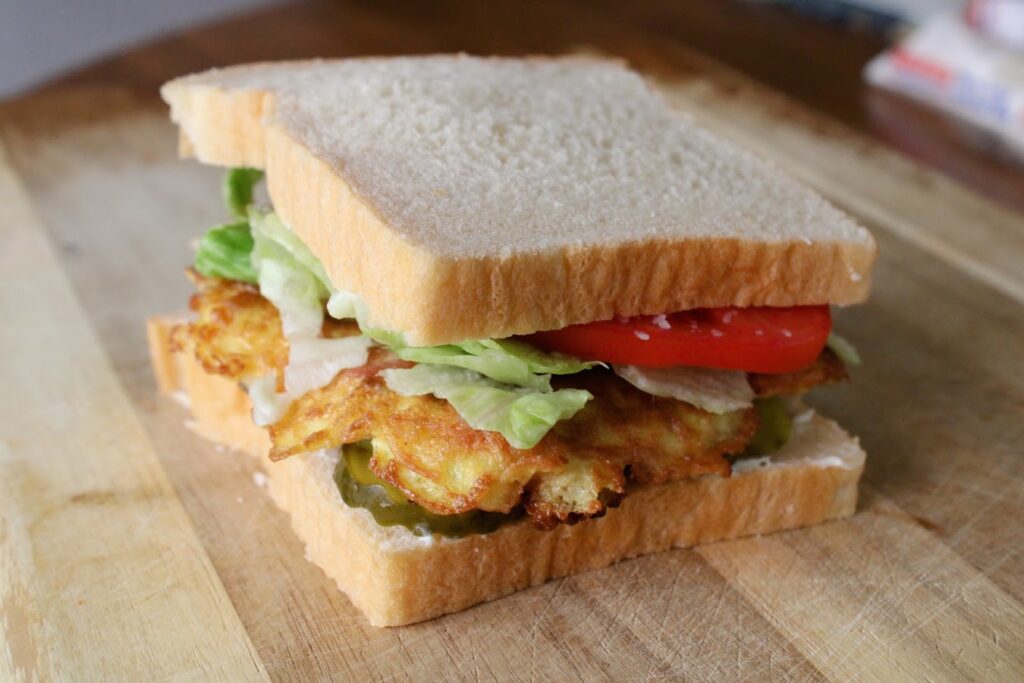
This week, we turn a fried egg omelet packed with protein and vegetables into a sandwich you can now only find in Missouri. This egg-focused sandwich likely started out with slightly different ingredients than you’ll find in it today, and it very likely was available in restaurants across a larger swath of the United States when it was first introduced. What changed, and why can you only find it in Saint Louis?
This isn’t my first foray into omelet sandwiches. I’ve covered tons of egg sandwiches, including a copycat of Denny’s Grand Slamwiches in meat and veggie versions.
What is this sandwich?
The sandwich this blog post is focused on today is the Saint Paul sandwich—which I will be referring to as the St Paul sandwich—which you can really only find on menus in Chinese restaurants in the Saint Louis area of Missouri. Read that sentence again if you need to, or just keep plundering along. I’ll explain a bit more.
A St Paul sandwich is made with a base of an egg foo young patty that could include chopped up protein like ham, chicken, or seafood. Then that fried egg, veggie, and protein patty is layered inside of cheap white bread with lettuce, tomato, pickles, and mayonnaise. Sometimes onion is added, but typically the onion is mixed into the egg foo young patty along with other veggies like mung beans, cabbage, and/or carrots.

But why is a sandwich named St Paul only located in St Louis? And why is it almost only found in Chinese restaurants? First, we need to get into some history.
Who or what is Saint Paul?
Saint Paul, the person, is the name of both a Christian saint and the capital city of Minnesota. Paul, who was born with the name Saul, was a Christian apostle who is traditionally credited with writing a large portion of the New Testament of the Bible. Paul is considered to be an apostle, but he was not one of Jesus’ 12 disciples, and while they both lived during the same time period, they are thought to have never physically met.
There is a lot more that could be said about Paul the apostle and his impact on Christianity, but I am not the sandwich blogger to cover that. What I can say definitively is that Paul never consumed an egg foo young patty or the sandwich that was possibly named for him, and he certainly did not visit the capital city of Minnesota that took on his name either.
St. Paul, the city, was originally called Pig’s Eye or Pig’s Eye Landing after a nearby popular tavern. It wasn’t until 1841 that a Catholic missionary named Lucien Galtier commissioned a chapel to be built on a hill above the settlement that he named for Paul the Apostle, otherwise known as Saint Paul. Galtier then encouraged the use of St. Paul to denote the settlement and encouraged citizens to stop calling it Pig’s Eye.
St Paul sandwich history
But why is a sandwich from St Louis named after St Paul? Is it named after a town or after the Christian saint? To make any attempt to figure that out, we really need to dig into some history.

As usual, when it comes to sandwich lore and history, we can often fall back on Jim at the Sandwich Tribunal, who has done pretty thorough research into the St Paul sandwich. Jim’s research found a great snippet from a book called Devil at the Confluence: The Pre-war Blues Music of Saint Louis Missouri that was written by Kevin Belford. That quote from a book that’s extremely expensive on the second-hand market goes on to cover a bit of the history of the St Paul sandwich.
…the history of the St. Paul sandwich has been an established St. Louis restaurant item now for at least one hundred years. It seems very likely that the various Asian, African and European immigrants in the densely populated city was the unique combination of factors that contributed to the creation of the Americanized Egg Foo Yung sandwich with the Catholic name – the Saint Louis Saint Paul.
Kevin Belford, Devil at the Confluence, 2011
This led Jim to investigate and get a bit of documentation for himself, so I tried to see if I could find anything that he might have missed or anything that was scanned into online archives after he covered his own blog post about the St Paul sandwich.
Many sources cite that a person named Steven Yuen, who owned a restaurant called Park Chop Suey, invented the St Paul sandwich. Some say he invented it in the 1970s, and some have even claimed that he invented the sandwich in the 1940s. Park Chop Suey wasn’t even around in the 1940s, so I’m not sure where all of that came from, but there are many sources available online that show that this sandwich, or a sandwich similarly named, existed well before the 70s or the 40s.


In cookbooks going back almost 80 to 100 years, you’ll see St Paul sandwiches listed right beside a Western sandwich or, the more modernly named, Denver sandwich, which is typically an omelet sandwich that contains meat, onion, and green pepper. If you’ve been reading along, you’ll note that this is also very, very similar to the old versions of the St Paul sandwich. The Denver sandwich is thought to have been invented in 1907.
There are many claims about the origin of the Denver sandwich, but famous food writer James Beard has claimed the Western/Denver sandwich might have been invented by Chinese cooks who were feeding railroad gangs in the late 19th and early 20th centuries. So the Denver/Western sandwich and the St Louis sandwich could have a very similar origin story.


To me, it’s clear from some of the sources that Jim found and some of the sources that I have seen that someone was making egg- or omelet-focused sandwiches and naming them Western/Denver or St Paul sandwiches at the very least 100 years ago. These sandwiches did not seem to have the Americanized Chinese egg foo young ingredient twist at that point, but it’s not far-fetched to think that they could have been very similar, with slightly different omelet ingredients.
All of this proves to me without a doubt that the owners of Park Chop Suey did not create or invent the St Paul sandwich. There’s a very good chance that Steven Yuen of Park Chop Suey was able to give the sandwich a lot more life and popularity throughout the city, but they definitely did not invent the sandwich or even give it the name of St Paul. They possibly did give the St Paul sandwich its more modern interpretation with more egg foo young components.
If you want to read more about St Paul sandwiches, check out The puzzling St. Paul sandwich from Restaurant-ing through history, and you can also read what some of the Wait Wait … Don’t Tell Me writers thought about the sandwich way back in 2013.
St. Paul, Missouri?
One angle that I haven’t seen anyone else mention is that the sandwich could be named after a town, but maybe not the Saint Paul in Minnesota. A quick Google search lets me know that there are at least 12 incorporated cities named Saint Paul or St Paul in the United States. In fact, there is a St. Paul, Missouri, that’s just 20 or 30 miles away from the edge of St. Louis. Could the sandwich have come from there?
The Catholic church in what is now known as St. Paul, Missouri, was given its name in 1859, which then led the town to accept that as its name as well. Before that, it was called Dog Prairie. There’s still a Dog Prairie Tavern in town that lists all of this as part of its history. Unfortunately, that tavern does not have a St Paul sandwich on the menu.
The closest St Paul sandwich that I could find to the town of St Paul was in O’Fallon at No. 1 Chinese Restaurant.
None of this rules out that the person who possibly created the original St Paul sandwich might have simply been from or located in a town known as St Paul and named it after that. We simply do not know.

It seems to me that the St Paul sandwich could have been invented when the Western/Denver sandwich was invented, by Chinese cooks who were basically making egg foo young into a sandwich. And then it was seen and cooked by non-Chinese cooks and restaurants and basically cooked with American-style ingredients plus egg until sometime around the time that Park Chop Suey opened in 1974. At that point, I’m guessing that Steven Yuen realized that the St Paul sandwich was almost the same thing as the egg foo young that they were currently selling and adopted it and firmed it into St Louis history and culture.


So there’s a good chance that the St Paul sandwich has come full circle. It was likely invented by Chinese cooks in the late 1800s while cooking for railroad workers. Then the Western/Denver sandwich and the St Paul sandwich both shifted slightly from each other for a few decades while using fairly American ingredients. The St Paul sandwich faded a bit from interest until the mid 1970s where a St Louis restaurateur decided that it could be featured as an offering on their Chinese restaurant menu, and now it’s exclusively produced by cooks who are cooking Americanized Chinese cuisine.
Park Chop Suey
My wife and I caught the Amtrak to St Louis last year, and we tried to visit Park Chop Suey, but they ghosted us. We were only there a couple of days; they do not open up on Sunday, so we ended up missing our window.
We were walking around from place to place (St. Louis is not really a very walkable place), and we walked up to Park Chop Suey at 12:35 on a Saturday to see an empty parking lot (front and back) and no sign of any life. According to Google Maps, they were supposed to be open that day by 12:30, so even if they were just delayed in unlocking the doors, I would have expected to see some life inside.

Maybe they were closed for some sort of event, but without a social media presence and without any mention on their website, they simply weren’t open. Guess I’ll catch Park Chop Suey on my next trip to St Louis.
We ended up walking another 3/4 of a mile and visited a nearby craft brewery for lunch and pivoted to eating a St Paul sandwich the next day instead.
One day later
I’m an early riser, so I got up and did some research into who in the St Louis area might have a good authentic St Paul sandwich. There were a lot of opinions online, but there were also a lot of people on Reddit who said things like, “go to any restaurant with Chop Suey in their name.”

I settled on visiting the closest Old St. Louis Chop Suey location that also had a small brewery within a fairly short walk—because I know my priorities. This was based on the top reply in a Reddit thread from a couple of years prior.
We Ubered over and hit the counter service to order a St Paul sandwich.
Old St. Louis Chop Suey is deeply embedded in a suburban-style shopping center with a Harbor Freight, Subway, and even a Planet Fitness all sharing the same parking area. It’s definitely an unassuming place where you walk in and place your order at the counter, and then they bring your food when it’s ready.


I asked the person taking our order which egg foo young option I should choose, and she said I should try the one with a few different meats mixed in with the egg. I also ordered some crab rangoon, and my wife had what she will tell you was a very good order of ramen.
The St Paul sandwich was about what you could imagine if you’ve ever ordered egg foo young from a delivery-style American Chinese restaurant. The bread was super simple and soft white bread that had a nice, thin layer of mayonnaise. There was some crunch from the lettuce, and you noticed the mung beans and other veggies inside of the foo young patty. Everything was savory with just a touch of pickly acid, which was very helpful.
This sandwich is one of those sandwiches that will remind you of the bologna or ham sandwiches you might have eaten as a kid, where the soft bread just sort of sticks all over the inside of your mouth while you’re taking a bite.


Was this a great sandwich? I would not call it great. It was good. I enjoyed the sandwich, but since it’s not something I have any nostalgia for, it’s a little bit lost on me. I wonder if toasting the bread just a little might help because everything gets a bit soft and texturally similar. I probably should have tested this in my versions, but instead, I made them exactly as they’re supposed to be.
Now that we finally know what sandwich we’re making, we’ll need some bread.
Slices of soft white bread
The St Paul sandwich requires some soft white bread slices. I used my Pullman pan with lid to create a large rectangular loaf, which would create quite a few soft slices to be used in a few St. Paul sandwiches.
This loaf of bread recipe makes a 13-inch-long loaf, which will end up making 8 or more sandwiches if you slice the bread around 1/2 inch thick. The slices will be soft, and they’ll probably be best in a sandwich if you toast them, but for some reason this sandwich uses untoasted bread. Shaping the loaf is very easy, and I’ve covered this recipe quite a few times, which you can check out if you’d like to make a loaf of your own.


Here’s my large Pullman loaf recipe that makes a mean, soft white bread slice. You can just buy some Wonder Bread if you don’t want to make your own. But my recipe is one of the easier breads you can make, so give it a shot if you need some good grilled cheeses or a more interesting PB&J.

Pullman loaf bread
A soft white loaf with square slices that are perfect for grilled cheese or Texas toast. Slice as thick or as thin as your sandwich situation requires.
Get RecipeEgg Foo Yung patty
I had never made egg foo young before starting this blog post, but if you can cook an egg and chop some veggies, it’s very easy. I had also never really ordered egg foo young before trying my first St Paul sandwich in St Louis last year. I have since ordered it from our favorite local Chinese delivery spot, but it’s still not really one of my favorite dishes that I order often.
The gist of egg foo young is that it’s a whisked egg that is packed with a lot of accompanying ingredients. The mixture will seem like there’s way more protein or veggies than egg, but during the cooking process the egg expands and fills in all the spaces between fillings.


One egg per patty doesn’t seem like it would be enough, but when it’s mixed in with the ham and vegetables, it fills out and turns into a pretty substantial patty. For my egg foo young patties, I added some chopped up ham steak, shredded carrots, mung bean sprouts, and green onion. As I’ve said in a couple of places, it will look like you have too many ingredients for just one egg, but it will all work out; I promise.
I try to pour the egg mixture into a circular shape, but while the first side of the egg foo young patty fries, you can use your spatula to tighten the exterior into a patty that’s about the same size as your slice of bread.


If you order egg foo young from a Chinese restaurant, I’m pretty sure they are deep-frying the patties in a wok or even a deep fryer. At home, it’s much easier to shallow fry or pan-fry the patties in just a couple of tablespoons of oil. I do suggest that if you’re really interested in trying an authentic St Paul sandwich without going to St Louis, just order some egg foo young from your favorite Chinese delivery restaurant and make the sandwich yourself. All the other ingredients are super easy to source, and you can test the sandwich without too much effort or commitment.
Mayonnaise and veggies
A typical St Paul sandwich will come on soft white bread that is normally untoasted. The bread will be coated on the inside with mayonnaise, and the typical veggies added should be tomato slices, shredded or chopped lettuce, and dill pickles.
Obviously, you can order your St Paul sandwich with no tomatoes if that suits your fancy or if you’re following along and want to make your own version, you can use whatever ingredients you’d like. I did not do this in any of the versions of sandwiches that I made, but I think mustard and a bit of sliced red onion could be good additions.

St Paul sandwich photos and recipe
Below are some photos of the St Paul sandwiches that I made. Two of the photos contain egg foo young patties that I ordered from my local Chinese delivery.
I’ve seen people on the internet during my research of this sandwich say things like, “I’ve moved to Texas and miss eating St Paul sandwiches, and no one here knows what I’m talking about. But all I have to do is order an egg foo young patty and make the sandwich myself.” So for a test, after I made the first loaf of bread, that’s what I did as well.


St Paul sandwich

This egg foo young-focused sandwich can be found on menus at Chinese restaurants in the greater St Louis, Missouri, area. But it's also very easy to make. To really simplify things, you could pick up or get egg foo young delivered from a nearby Chinese restaurant and start the sandwich with those.
Ingredients:
Egg foo yong patty- 1 whole large egg
- pinch of salt
- pinch of white pepper or black pepper
- pinch of garlic powder
- 1⁄4 cup mung bean sprouts, roughly chopped
- 1 green onion, finely chopped white parts
- 1 to 2 ounces ham steak, cut into small pieces (a bit less than 1/4 cup)
- 1 to 2 tablespoons carrot, shredded with a peeler and chopped into small pieces
- 3 tablespoons neutral oil
- 2 slices of white bread
- 2 to 4 teaspoons mayonnaise
- 4 to 6 dill pickle chips
- iceberg lettuce, chopped or shredded
- 1 tomato slice
- salt and ground black pepper
Directions:
In a medium bowl, add spices to a whole large egg and then whisk. Add in all of the vegetables and/or ham; stir to combine.
Add three tablespoons of oil to a medium pan over medium heat. When the oil is shimmering, pour the egg mixture into the oil and fry the first side until it's browned and set, about 4 minutes or so. While the first side is frying, tighten up the egg mixture with your spatula to keep it in a circular shape around the size of your piece of bread.
Once the first side has browned, flip the egg foo young patty and cook for another 3 minutes. After 3 minutes, move the egg foo young patty to a paper towel-lined plate or sheet pan while you prepare the rest of the sandwich
Add a thin layer of mayonnaise to two white bread slices and then add as many pickles as you desire to the bottom slice.
Top the pickles with the egg foo young patty, then add lettuce and the tomato slices. Salt and pepper the tomato slices and then close the sandwich. Serve and enjoy
Check back next week
Next week I’ll be writing about a sandwich I enjoyed twice during my recent trip to Seattle, Washington. Subscribe and get notified directly in your inbox when the content drops.
.JPG)
Steph Chabot says:
So what we call a "Western" is actually a "St. Paul" and a "Western" is actually a…OMG WTF IS THAT THING?!?!
Jonathan Surratt says:
If James Beard is to be believed, a Western sandwich, Denver sandwich and St Paul sandwich were all born at around the same time and probably were the same thing at one point. But my limited understanding is that a Western sandwich is now closer to an omelet in a sandwich now?
Jeff Gentry says:
Don't make it to STL often but when I do, I always stop by Park Chop Suey!
Jonathan Surratt says:
I tried! 😂
Jeff Gentry says:
First time I went it just happened to be the spot in easy walking distance. Had no idea the (potential) back story!
dub273 says:
I've not heard of this sandwich until you posted. Another St. Louis culinary innovation that didn't stay too far from the arch!
Jonathan Surratt says:
I like this one a bit better than provel! 😂
A.G. Pasquella says:
@swordsjew.bsky.social Relevant to your interests