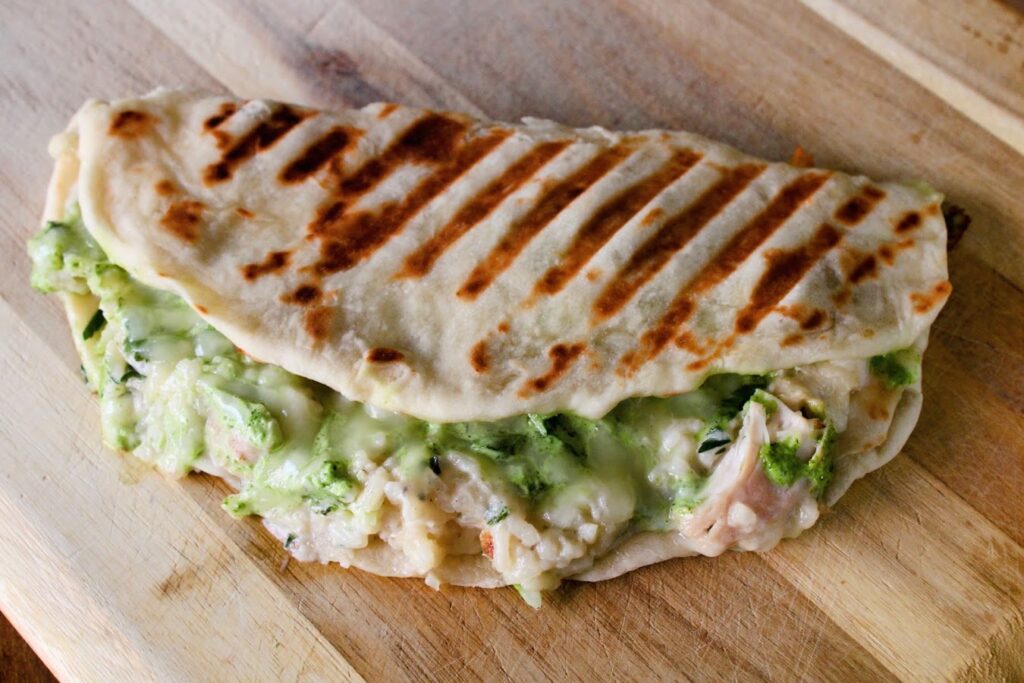
The words in the title of this sandwich blog post may be a bit confusing, but all you need to know is that this whole post is centered around a comforting, warm, and melty handheld/sandwich experience that’s crispy on the outside and soft, fluffy, cheesy, and savory in the middle. Last week I wrote about a panini that’s not panini-ed, but this week, I’m sandwich-adventure-course-correcting, and I’ll be pulling out the panini press and creating a tasty folded-over sandwich.
No broccoli harmed
That’s not broccoli casserole in the photo above, but it sure does look like it. I’ve written about broccoli casserole in a crunchwrap before, and I’ve also covered a fantastic broccoli reuben. You definitely can broccoli a sandwich.
Oh, and there might be some trademark drama that we stumble into along the way.
What is this sandwich?
Some might say this isn’t a sandwich, and I’d say they’re wrong.
This is a recipe where a comforting, savory, and creamy combo of chicken and rice is added inside of a naan-style flatbread along with shredded Monterey Jack cheese. Then a sauce made from cilantro, mayonnaise, garlic, lime juice, parmesan cheese, and a couple of other ingredients is drizzled on, and a bit more chopped-up cilantro is added to make sure things stay healthy. The flatbread is folded over on top of the components, and the whole sandwich is warmed through in a panini press.
This is a chicken and rice naanini.

What the heck is a naanini?
A naanini is not something I invented. This time, someone else is responsible.
Fonty’s Deli + Dukaan, located in the West Village of Manhattan, claims to have invented the naanini, and they use that vessel to serve Indian-ish sandwiches with names like chicken tikka naanini and Kerala beef naanini.
I have made and written about a few sandwiches with a similar concept—I call them flatbread melts—but not quite the same tactic for warming through and serving. I learned about Fonty’s and their naanini from a New York Times food video about a new hit sandwich from NYC.
I think a sandwich is a beautiful example of a cross-pollination of culture. All you need is a bread, a filling, some sauces to go with it and some texture, and that can come from anywhere. And I think that’s an embodiment of immigrants or somebody who has traveled, who have crossed borders before they have crossed streets.
Viraj Borkar – founder and Co-owner, Fonty’s Deli + Dukaan
If you didn’t watch the video above and still don’t know what a naanini is, Fonty’s naaninis are exactly what you might expect when you realize that the word naanini is a combination of the words naan and panini. You take a round piece of flatbread, spread fillings on one side, fold the naan over to cover the fillings, and then press it in a panini press to warm things up and crisp up the exterior of the bread.
Fun fact: Arjun Gupta, one of the co-owners of Fonty’s, is a working actor known for his roles in Nurse Jackie and The Magicians.


In the video, you might have heard Viraj Borkar mention that they will be trademarking the word naanini (timestamp in video: 32 seconds).
Naanini trademark dispute?
Fonty’s naanini trademark request might be a problem, though. According to the US trademark search, Fonty’s (under Krupaya Dhanyavad NY Holdings LLC) applied for the trademark on June 1st 2026. But that video shared above was released in April of 2026, and someone else submitted a trademark request directly referring to sandwiches on April 21st 2026. That naanini trademark request was submitted by the owners of a restaurant in Chicago called Bhoomi Modern Indian Grill. Both trademarks are currently pending, and I’m definitely not an attorney who deals with anything like this regularly, so they both might be able to claim a mark for what they wish to use it for, but it seems to me that Fonty’s could possibly have waited too late to secure this.
In a last-minute twist to the trademark drama, Bhoomi Modern Indian Grill closed on June 27th, 2026, but they have not abandoned their trademark request and claim on Instagram that they are looking for a new location.
Below, I have shared a screenshot of the trademark class that both companies applied for. IC stands for International Class, which is a way for the United States Patent and Trademark Office to organize goods or services used in trademark applications.


Again, I want to state that I’m not a trademark attorney, but it seems like Bhoomi Modern Indian Grill has a much cleaner stake on the name naanini in reference to sandwiches, specifically panini-style sandwiches, and it also mentions that their first use in commerce was July 30, 2025, and Fonty’s was a couple of months later, on September 6th.
Anyway, I’m not selling naanini’s, and I’m not charging you to use my recipe, so I think I’m safe to use the word here. Let’s tackle the next major component in this handheld.
What is chicken and rice?
It’s literally what it says: a dish made from chicken and rice. You’ve likely eaten chicken and rice because pretty much every culture around the world that has both rice and chicken available to them has some sort of chicken and rice pilaf or one-pot chicken plus rice dish or casserole. And many of the chicken and rice dishes around the world seem to share some form of the following ingredients and process.
- Chicken – bone-in or boneless, thighs or breasts or even legs.
- Rice – long grain or basmati or sometimes even a wild rice mixture
- Aromatics – onion, garlic, carrot, celery
- Liquid – chicken broth, stock, wine, or even just water
- Fats and spices – butter or olive oil, black pepper, paprika, cumin, saffron, or even curry powders
The process starts with browning the chicken in the pan, but you don’t fully cook it at this time; then either toast the rice or add the aromatics to the pan to soften. After that, the rice goes in with the liquid and parcooked chicken, and the fat and spices are added throughout the process. The dish is done when the chicken is fully cooked, and the rice has softened and absorbed a lot of the liquid.
This is the process for many recipes, like Spain or possibly Puerto Rico’s arroz con pollo and chicken and rice pilaf, and you’ll even find recipes for things like chicken and jollof rice similar to what might be made in Western Africa that call for the cooking process to be very similar but with more ingredients like tomatoes, ginger, and bell pepper.
These recipes go back hundreds of years, and we have culinary historians digging as far back into the origin of these chicken and rice recipes as they can, uncovering even older or alternate versions like Valencia rice, which apparently is a cousin of the Mexican version of Spain’s arroz con pollo.
I like rice. Rice is great if you’re really hungry and want two thousand of something.
Mitch Hedberg, rice comedian
In the Southeastern United States, we have chicken and rice-focused dishes like Country Captain, which includes tomato and curry powder. There’s South Carolina’s pleasantly named Chicken bog, which is sometimes called chicken pilau (or pileau or perlo) and includes smoked sausage and various spices.
There are even one-pot chicken and risotto recipes that have the same vibe as the recipe that I used to create my chicken and rice for this sandwich. Do not tell the Italians this, though.
What makes my version Southern-ish?
This is a hard question to answer.
I think it might be the simplicity of the whole concept of using chicken, rice, and simple seasonings that makes it different from more elaborate chicken and rice recipes. Vivian Howard, a well-known chef and PBS television star who grew up about an hour east of where I grew up in North Carolina, has an unbelievably simple chicken and rice recipe that she learned from her mom, Scarlett Howard. She calls it Scarlett’s chicken and rice, and she also refers to it as a “bog” in the description of the recipe.
Chicken and rice casserole is also a fairly popular recipe in the United States. This is likely due to Campbell Soup releasing their “cream of” soups in the mid 1940s and promoting their use in chicken and rice casseroles or one-dish chicken and rice bakes.
There’s probably a whole lot of other people that are outside of the Southern US who are making something almost the same as this with chicken and rice. Regardless of whether it’s Southern-ish or not, it’s tasty and comforting, and I suggest you make it. But before we get to that, let’s talk about the bread.
Homemade naan
Naan comes from Central Asia or Persia, and in that area of the world, the word is simply a term to represent any type of bread. It is believed that naan migrated to the Indian subcontinent in the 1300s because that’s when it appeared in poet and scholar Amir Kushrau‘s notes. At that point, naan in Southern Asia was associated with the royals and wealthy society, and it wasn’t until the 1700s that regular citizens were eating naan. The first English use of the word naan appeared in William Tooke’s writings about travel. Tooke spelled the name of the bread as nan, but at some point later the word was adjusted to how we spell naan today.
Naan is different from a lot of flatbreads that are made in those areas of the world or flatbreads that existed during those time periods because it is leavened with yeast, and it takes a bit longer to make than unleavened breads of the region like roti or chapati.
The word naan means bread. This means that saying the phrase “naan bread” is similar to saying ATM machine.
Don’t do it.
Since naan contains yeast, it requires a bit of rise time, and naan recipes will specifically require yogurt and ghee or butter as some of the fat and moisture in the dough. Other than that, if you’re not attempting to create the most traditional naan, it’s much like making pizza dough. First, you combine ingredients into a dough, then you let it rise for a bit. After that, you can portion the dough and roll it out. Then naan in a home kitchen most often is cooked in a pan or on a griddle instead of being baked in an oven or tandoor.


I’ve covered this many times when writing about flatbread and tortillas, but if you’re making flatbread on a pan or griddle, you absolutely cannot skip the final step where you rest your cooked naan in a folded-over clean kitchen towel. This step is part of the cooking process, and it helps to finish cooking the naan as well as softens the naan by steaming it under the towel.
Just like all other types of bread, the moment it is removed from the heat, the middle parts of the dough are still cooking. This is the same as the carryover cooking process when you cook large pieces of meat. The middle is still warm enough that if you immediately cut into the naan, it will not be finished with its process.
Find a clean kitchen towel and do not skip the final steaming step.


Here’s my naan recipe that I converted from my puffy flatbread recipe to contain yogurt and butter as the fat and some of the liquid/moisture in the dough. If you want to make this sandwich quickly, you should easily be able to find some flatbread or even naan at your local store and get started.

Homemade naan
This flatbread recipe creates a puffy naan to accompany your next meal. Paint some melted butter and minced garlic on top to create an even more flavorful experience.
Get RecipeSouthern-ish-style chicken and rice
This is a one-pot recipe that creates a savory, creamy, and comforting main dish that you could serve for dinner alongside a veggie side dish or two. Or you can be crazy like me and make a whole batch in order to use in sandwiches throughout the next few days. It works both ways.
If you do decide to make this recipe, I would suggest that you eat it as your main course when you first make it and then use the ample leftovers for naanini sandwiches.
For my chicken and rice recipe, I lean hard on the savoriness with extra Better Than Bouillon and MSG added when the broth is added. My personal favorite part of my chicken and rice recipe is the savory comfort, and I think these two optional additions do add something that helps the finished dish.


The recipe itself is pretty easy. Cook some diced onions in butter, then remove them from the pot. Using a teaspoon of butter at a time, cook small batches of your 2 pounds of chicken pieces (I used thighs) cut into 1-ish inch pieces, with just a little salt and pepper. Cook the chicken about 3 minutes per side until it gets just a bit of browning and then remove the chicken to the bowl with the onions.
After the chicken is cooked, add all of the rest of your ingredients except for the heavy cream, parmesan cheese, and parsley into the pot still over medium heat and dump the onions and parcooked chicken back into the pot as well. Stir everything together, bring to a boil, reduce heat to low, and simmer with the cover on for 20 minutes.
Uncover the pot, add the cream, cheese, and parsley, and stir to combine. Serve and enjoy. Also, I’m not totally sure why I put the whole recipe instructions here because they’re also down in the full chicken and rice recipe and the full chicken rice naanini recipe as well. These are just paraphrased.


When you make this recipe, it makes at least 6 portions, which might translate into more than 6 sandwiches, so you’re likely to have leftovers. Reheating works pretty well in the microwave or in a small pan, but I suggest you add a couple of teaspoons of cream, broth, or even water to help things stay moist. If you’re microwaving, just stir things up after heating with the liquid, and the chicken and rice should be just as moist and comforting as it was the first time.


Southern-ish-style chicken and rice
This comforting and savory main course, focused on tender chicken and rice, makes you feel like you're eating a warm hug from someone's grandmother.
Get RecipePeruvian green sauce aka aji verde sauce
Aji green sauce is an old sauce that was possibly being made way back during the time of the Incas throughout the Andes mountain range. If you’re like me and you’re not up to date on your Inca Empire timeline, that means a version of Aji might go back as far as the early 1500s. The Incans called this sauce uchu, but the name has changed to Aji because the sauces are typically made from aji peppers.
Aji verde will differ from country to country and person to person, but in Peru, they mostly have turned the green sauce into a creamy sauce containing mayonnaise, sour cream, and parmesan cheese (or other types of grated cheese). This is my take on a Peruvian green sauce that contains a whole bunch of cilantro, small stems and all, jalapeños, garlic, lime juice, vinegar, oregano, and various other spices.

In Peru, this aji verde will be drizzled on top of potatoes, meat, ceviche, and sandwiches. J. Kenji López-Alt has a vinegary Peruvian grilled chicken recipe with aji verde that I suggest you check out. I also drizzled some of the leftover sauce I made for this sandwich on top of an omelette that I made, and it was a fantastic addition.
I was looking around for some way to blast my chicken and rice filling for this naanini with both color and flavor, and this sauce hit the spot. If you’re one of those cilantro-tastes-like-soap people, I must apologize. You could try this recipe and replace the cilantro with Italian parsley, or you could pivot to a pesto recipe or even something totally different like a sun-dried tomato spread, and you’d still have a fantastic sandwich experience.
All ingredients go in a blender, and that’s the whole recipe. The hardest part is clean up.


Aji verde sauce (Peruvian green sauce)
This tangy and cilantro-forward sauce is great as a sandwich spread, but you can drizzle it on pretty much any grilled meat or seafood, and it's even great mixed into cooked rice to change up the flavors.
Get RecipeCheese
This is the easy part of this sandwich, and honestly you could leave it out. The rice and chicken are so creamy, and the sauce is creamy, so more creaminess isn’t exactly needed. But I did it anyway, and I put it in the recipe because the whole point of a panini is to melt the insides of the sandwich until everything is warmed and the exterior is crisped. The melty cheese also has a side benefit of keeping the components and therefore the sandwich from becoming too messy.
I used Monterey Jack because it’s basically default, cream colored melty cheese that really won’t rock any boats when it comes to bringing additional flavors. But cheddar and provolone would have been my next choices if I didn’t find Jack. Shred your own cheese though; it makes a difference when it comes to melting.

Panini process
The process for turning these naans and fillings into sandwiches is easy, and I’ve created a photo slideshow that you can swipe through to see what I did.
First I warmed a naan to make sure it’s pliable, and then I added cheese, topped with some warmed chicken and rice. Next was a bit of ripped-up cilantro and a nice drizzle of aji verde sauce. More cheese was added, and then the naan was folded over.


The next step requires a panini press machine or a cast iron skillet with another heavy skillet that you can use to press down on the sandwich. I have a 15-year-old Cuisinart “Griddler” that has been a workhorse that has pressed down hundreds of sandwiches in our house.
I add just a couple of drops of vegetable oil to the outside of the naan and griddle until the exterior has nice grill marks and the interior is starting to try to escape. Then the naanini should be done and ready to eat.


Chicken and rice naanini photos and recipe
As usual, I probably made and took too many photos of my version of these naaninis. You can scroll past them to get the full recipe for this creamy, savory, and massively comforting sandwich that looks a whole lot messier than it actually is.
Even if you don’t try the sandwich, you should use my chicken and rice recipe if you simply want a good main course to accompany some boring vegetables like broccoli or Brussels sprouts.


Chicken and rice naanini with a tangy green cilantro sauce

This comforting chicken and rice naanini sandwich is balanced by a tangy cilantro sauce, tucked inside a melty and warm sandwich.
Ingredients:
Aji verde sauce- 1 1⁄2 cup cilantro leaves and smaller stems, packed
- 2 large jalapenos, stem and core removed, chopped
- 3⁄4 cup mayonnaise
- 3 cloves garlic
- 2 tablespoons parmesan cheese, grated
- 2 tablespoons olive oil
- 2 tablespoons fresh lime juice
- 1 tablespoon white vinegar
- 1 teaspoon dried oregano
- salt and black pepper to taste
- 3 tablespoons butter, divided
- 1 large onion, diced
- 4 to 5 boneless skinless chicken thighs (or 2 breasts), cut into 1 inch pieces
- 3 cups chicken stock
- 1 teaspoon Better Than Boullion brand chicken base (optional)
- 1 teaspoon salt
- 1 teaspoon ground black pepper
- 1⁄8 teaspoon MSG (optional)
- 1 1⁄2 cups long-grain white rice
- 1⁄2 cup heavy whipping cream
- 3 tablespoons Parmesan cheese, grated
- 2 tablespoons fresh parsley, chopped (optional garnish)
- 1 large naan
- 1⁄3 cup Monterey Jack or provolone, shredded
- a sandwich sized portion of chicken and rice (1/4 to 1/2 cup - from above)
- 5 or 6 cilantro leaves, chopped roughly
- a drizzle of aji verde sauce (from above)
- olive oil or vegetable oil
Directions:
Aji verde sauce: combine all ingredients in a blender and blend until the sauce is smooth.
Transfer to a sealed container and store in the refrigerator for no more than 2 weeks.
Chicken and rice: add a tablespoon of butter to a large pot over medium heat. When the butter is melted, add diced onion and cook for 5 to 6 minutes or until the onion starts to soften.
Remove all of the onion to a large bowl and add a teaspoon of butter to the pot. Add in just enough chicken pieces to cover the bottom of the pot but try not to crowd the pieces too close to each other. Cook for 3 minutes, flip each chicken piece, and cook for an additional 2 minutes, then remove the chicken pieces to the bowl with the onion. Cook the chicken in batches with a teaspoon of butter each time until all of the chicken pieces have cooked for about 5 minutes. The chicken will not be fully cooked at this point, but it should have gotten a little bit of browning on the exterior.
Once all the chicken has been cooked a little and then moved to the bowl, add stock, Better Than Bullion, salt, pepper, MSG, and everything from the bowl with the onion and chicken in it, including any residual juices. Add the rice, stir everything in the pot together, and bring to a boil.
Once boiling, reduce heat to low, cover the pot, and simmer for 20 minutes.
After 20 minutes, uncover the pot, add the heavy cream and Parmesan cheese, and stir everything together. Add parsley if desired and stir. Store in a sealed container in the refrigerator until time to sandwich.
Sandwich assembly: warm a naan by toasting in the oven or in a pan until it's a bit more pliable.
Warm the chicken and rice in a bowl in the microwave with a teaspoon of cream, broth, or water added. You can also do this in a small pot with just a bit of liquid added to make sure things stay moist.
The naan is going to be folded on top of itself, so you only want to put fillings on one side of the circle. Add half of the cheese to the naan and then top that with the warmed chicken and rice. Sprinkle on some chopped cilantro seeds and drizzle on a bit of the aji verde sauce.
Top the sauce with the second portion of cheese and then fold the naan over to sandwich the ingredients.
Panini: add a tiny bit of oil to the outside of the naan and place it in a panini press. If you do not have a panini press, you can use a hot cast-iron skillet with another skillet on top of the folded-over naan, pressing it down. This will grill the bottom side, and you will have to flip the sandwich, but it will work just fine.
Once the naan has browned on the exterior and the fillings seem warmed through, the sandwich is complete. Serve and enjoy.
Check back in two weeks
I’m taking a trip to Seattle and will be eating sandwiches instead of making them. Hit me up in the comments or on social media if you have Seattle suggestions.


Anonymous says:
This sounds YUM!
Jonathan Surratt says:
Thanks! It was pretty good.
CKWNY says:
You’ll have to try Alpaca next time you’re in NC
Jonathan Surratt says:
At first I thought you meant the animal!
Anonymous says:
🤣
SirBob42 says:
Seattle sandwich recommendation: Dingfelder’s Delicatessen. Its a kosher-ish deli with many fine sandwiches. The best is the Hot Beef Brisket, particularly with gribenes. Yes, its painfully expensive – even by Seattle standards, but totally worth it.
Jonathan Surratt says:
Thanks for the tips. I’ll try to check Dingfelder’s out. That sandwich sounds great!