The burger I’m writing about today keeps things super simple and laser-focused on the almost-perfect combo of meat, bread, and cheese with little to no distractions. We’re basing this concept on a burger that likely would have been lost to time if it weren’t introduced to the world by a renowned burger scholar.
Along the way, on this burger adventure, I review a—spoiler—great burger cookbook, and I test an alternate process for creating the Chester burger that has been named the Chester-Rouer.
What is the Chester?
Today we’re making the Chester. This is a burger with its origin along the beaches of Long Island, New York. The story goes that the Chester was invented by hungry teenagers who might have had a few alcoholic beverages and, when they got home, tried to make cheeseburgers, but they didn’t have any buns.
This lack-of-bun situation has likely happened to everyone reading this, but these teenagers didn’t just slap on some white bread slices with ketchup; they decided to combine the concept of a grilled cheese with a burger patty tucked inside.

None of this is shocking or even wildly innovative, but the next day, one of those teenagers visited the concession stand at their local Quogue, New York, beach club and asked them to recreate that grilled cheese cheeseburger experience, and it was such a hit that the burger concept got a place on the menu.
The teen who introduced this grilled cheese burger to the beach club menu was named Chester, and that name stuck as the burger’s name on the beach club menu.
Again, this is such a normal story that could have happened anywhere, but it just so happened that this burger story took place at the beach club that a young George Motz frequented during his time working as a lifeguard in his hometown.
Motz eventually left Quogue and grew up to be a world-renowned cheeseburger scholar with multiple books and even a restaurant in NYC that’s dedicated to cheeseburgers. And he’s the reason that anyone other than Long Island beachgoers is even aware of the Chester.

Motz never actually mentions which Quogue area beach club serves the Chester. I believe most of them are private clubs, so maybe that’s why. Here’s a link to the only photo that I was able to find of someone who purchased a Chester (with bacon) from Quogue Beach Club back in 2022.
So, through this story, we’ve learned the Chester burger is basically a grilled cheese with the addition of a seared beef patty. That’s it. A Chester is basically a hamburger melt or a cousin of the patty melt.
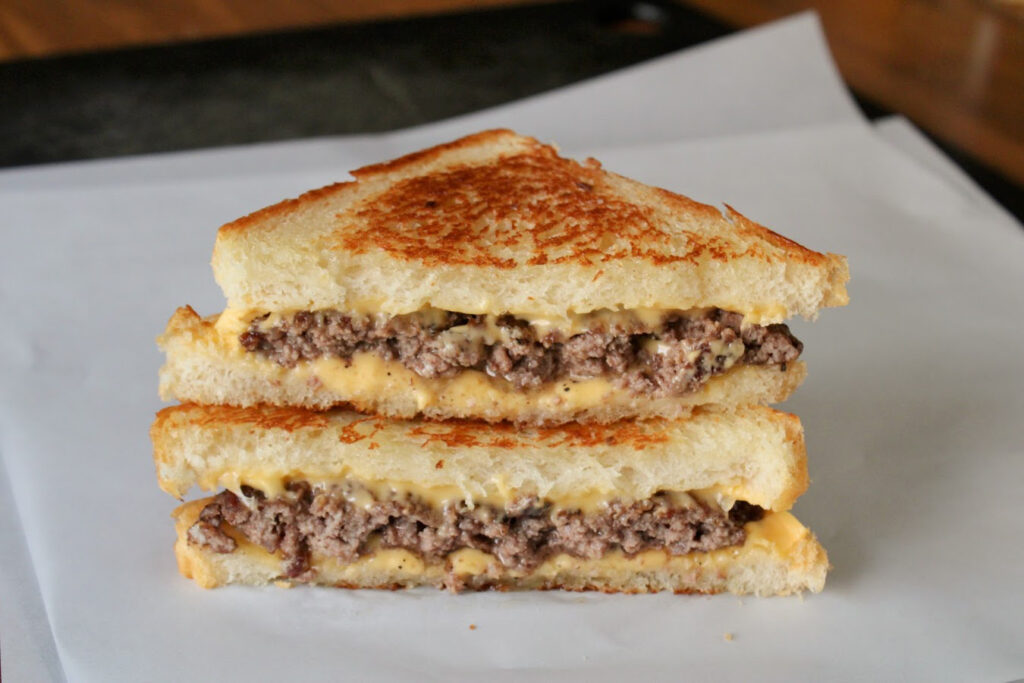
There are two buttered and toasted slices of bread that are sandwiching two slices of American cheese with what is probably a quarter-pound beef patty tucked in between. The slices of cheese are on both sides of the beef, which causes a lot of creaminess and keeps everything stuck together. The beauty of this burger is that it’s simple, yes, but also that everything is balanced. The burger works because the bread-to-burger ratio isn’t out of whack, and the cheese and buttery bread exterior match well with the savory and tender beef. Toasting the bread is essential to bring texture and just a little bit of chew that works great with the soft and creamy interior of the sandwich. No sauce, no mayonnaise or mustard, that’s it, that’s the Chester.
Back in June, 2024, Hamburger America in New York City hosted Chester Murray for the unveiling of the Chester special. You can still order that burger at the restaurant today. It’s not on the menu. You just have to ask for it.
George Motz used to make videos for First We Feast with a show called the Burger Show. At one point, he was regularly making videos about regional burgers, and the video I’ve added below contains the origin story and cooking process for a Chester.

Now that you’ve seen that video, you might think that you don’t need to keep reading. Well, you’d be wrong, because I have more to write! Keep scrolling, I promise I have more.
Is the Chester burger any good?
The Chester burger is extremely simple. There are literally just five ingredients—butter, bread, ground beef, salt, and American cheese. Ground black pepper is optional on Motz’s version. Doesn’t this mean it’s going to be boring and a downright dull burger?
No. Trust me, this burger is really good. Sometimes the simplest things are the hardest to pull off well. If you don’t salt the meat, it will be obvious. If you burn the toast, it will stand out. If you use too much meat or slice the bread too thickly, the balance and ratio will be off. Everything about this particular burger is so simple that nothing can hide. If you nail it, the Chester can be a perfect burger experience.
Could the burger be elevated by the addition of pickles or a sauce? Maybe. Would crispy or even raw onions bring texture and possibly some sweetness that the Chester is otherwise missing? Possibly. But getting to know exactly what this burger is all about made the lunches where I spent testing these recipes thoroughly enjoyable. And I will be making a Chester again.
Restaurant available grilled cheese cheeseburgers?
A grilled cheese plus cheeseburger combo isn’t just limited to private beach clubs in Long Island, New York. Several large restaurant chains sell combined grilled cheese and cheeseburgers, including Friendly’s, which George Motz mentions in his cookbook as a similar concept to the Chester. I’ve found a couple more, plus one variant that evolved from a secret menu that is close, but also different.


If you mention “grilled cheese cheeseburgers” around enough nerdy online-obsessed burger fans, someone will inevitably mention what used to be a secret menu option at Five Guys. Back in the day, you could special order a “grilled cheese burger,” but now they have it on the official menus as the Five Guys Patty Melt. This burger can be a similar experience to the Chester, but not quite the same.
If you’ve never been there, Five Guys is a burger chain that’s known for massive amounts of fries, free salted peanuts, and pricey-for-fast-food burgers. Early on in their existence, they only sold burgers, hot dogs, and fries, but each location would make sandwiches like a veggie sandwich on a bun or a grilled cheese using an inverted sesame seed bun if you asked nicely.

It was around this time that a secret menu started forming at Five Guys, and people were upgrading that inside-out grilled cheese and asking for burger patties in the middle, creating the grilled cheese burger. This meant you still got a burger, but the exterior of the bun was toasted, creating a different sandwich than a burger in a typical bun. The patty melt is now an official menu item, which means you can get a slightly similar burger experience to the Chester if you place your Five Guys order properly.
Is a Chester just a patty melt?
Is a Chester just a patty melt? Sort of, but not really. It’s a relative of the patty melt, but for burger enthusiasts, it’s not the same thing.
A true patty melt has several ingredients that really define it. A traditional patty melt will have Swiss cheese and grilled or caramelized onions inside, and the exterior will almost always be rye bread slices. The process of making the burger might be similar, but it’s the ingredients that keep the Chester from being an authentic patty melt. Maybe they’re cousins?

The Great American Burger Book
George Motz’s The Great American Burger Book (buy signed copies here) is a great cookbook. The hardback version would make a great coffee table conversation starter, but it’s much deeper than that. If you’re a fan of the style of my sandwich blog, you’d like this cookbook because it starts with a page or so of history for the upcoming recipe or location where the recipe was invented.
Then the book covers the recipe with simple ingredient lists and instructions, and then pretty much every single recipe has a photo of the finished burger and a page or two of images from the cooking process. You can tell that a lot of thought and effort went into this book.

This is a fantastic cookbook for people like me who love many photos of what I’m making, and also have things to read other than just recipes. I just bought this cookbook a couple of weeks ago, and I have only tested the burger recipe I’m writing about down below. I have thoroughly read through other burger recipes that I’m very familiar with, like the Oklahoma onion burger, the Pimento cheese burger, and what Motz calls the Carolina slaw burger, and they all seem like they’re founded on good burger principles, and the recipes read as if they would work very well. I definitely plan to keep reading and maybe tackle a few other burgers from this book.


The Great American Burger Book evaluation?
This cookbook gets top marks in my book, and I would put it down as a must-buy if you’re looking for a combination of American burger history, recipes, and delicious photos. Add it to your wish list, or if you have a literate friend/enemy who loves burgers, this would make a good gift.
But, enough about cookbooks. We need to discuss the burger at hand and bake some bread to stuff it inside.
Big rectangle of square white bread
The Chester probably uses a typical plain white bread that a beach club would have in stock to use for simple BLTs and grilled cheeses. In the United States, this typically means a slice of bread that’s about 1/2 inch thick and 4 to 5 inches square. We can easily accomplish those dimensions with homemade bread because most loaf pans are between 4 and 5 inches wide.
I chose to use my large Pullman pan and accompanying loaf recipe that I’ve been using for a few years at this point. It produces square slices of soft white bread that will be perfect for creating a 4 x 4 x 13-inch loaf that we can cut into 1/2 inch slices.
This loaf of bread contains pretty standard bread ingredients, except it does contain non-fat dry milk powder or powdered milk, which helps to give the loaf a fluffier crumb and creates a lighter resulting loaf. The milk powder will retain more water from the dough, which should extend shelf life, and it should also keep the dough moister while it bakes.


The Pullman pan played a significant role in standardizing bread loaves in the United States and elsewhere. Before its invention, French bakers had been baking in rectangular, lidded pans for a while, but a railway entrepreneur named George Pullman standardized his pan in the mid-1800s for use in the kitchens on his trains because it meant that the rectangular loaves and pans would help maximize space and efficiency in the small quarters of Pullman train cars.
The point of a Pullman pan in your own kitchen is less about creating efficient uses of space and more about baking a consistently square slice of bread for use as Texas toast or just a great vessel for creating a grilled cheese sandwich.

You don’t have to use the lid on a Pullman pan. You can bake without the lid to achieve a more domed slice of bread, but in my experience, the best part about these pans is the straight, non-tapered sides. A Pullman pan is what I reach for when I want a slice of bread that looks professionally baked.


I mentioned earlier, but I sliced the bread into roughly 1/2 to 3/4 inch thick slices. I slice by hand, so it’s sort of a guess as to the thickness, but I’ve found that size provides a good ratio of bread to meat if you’re using something close to a quarter pound of beef.


Here’s my large Pullman loaf recipe. If you don’t want to make your own bread, just look for a consistently sized white bread loaf at the store. It doesn’t have to be square slices, but squarish slices will make things a little easier when trying to get cheese and beef into each bite.

Pullman loaf bread
A soft white loaf with square slices that are perfect for grilled cheese or Texas toast. Slice as thick or as thin as your sandwich situation requires.
Get RecipeSeared beef patties
First things first. The Chester is not a smashburger. You could make it as a smashburger if you wanted, but this is just a regular griddle burger that’s fairly thin, so that it doesn’t overwhelm the ratio of bread to burger. The Chester is also not a burger that you’d necessarily want to cook on a charcoal or gas grill. I guess you could, but the expectation here is that you’re searing a patty and attempting to get a little crisp on the exterior, and you just couldn’t do that as well with grill grates vs a hot pan or griddle.
I don’t think this is the sort of burger where you need to grind your own meat. I bought 80/20 ground beef at the store and weighed it out into different-sized balls, and then shaped the balls into patty shapes. I tried both 1/4th and 1/3rd pound patties and found that a quarter-pounder or maybe just a little bit larger is the perfect size for the ratio between bread and meat to work properly. Don’t get me wrong, a third-pound patty worked just fine; it’s just a bit meat-heavy.
I know for a fact that my bread is right around 4 inches square, so I tried to make sure my beef patties were larger than that in order to account for shrinkage.

Get each component into each bite.
One of my goals when making each of the test versions of Chester burgers that I created this week was to make sure that each bite had butter-toasted bread, melty cheese, and seared beef. The bread and the cheese fit perfectly out of the box, so the main issue is making sure that my beef patty is correctly sized.


If I’m not making a smashburger, I like to form my patties on top of a piece of parchment paper. You can buy pre-cut squares of parchment, but I often will just pull off a piece of regular parchment and cut it down to size, so that I can have two or three patty-sized pieces, which is about a 6 x 6 or 7 x 7-inch square. Making your patties on parchment means you can form them and then wash your hands.
Once the patty is formed on paper, you can easily move the burger to your pan or griddle by holding the parchment, meaning you’re not touching the beef with your hands again. You can also season the exposed beef and then lay the burger down flat on the pan or griddle and press on the back side of the parchment to ensure that the meat has good contact with the hot surface, and then peel and dispose of the beef-ed up paper.


If you were really adamant about making sure that every square inch of cheesy bread was covered by a burger patty, the smart thing to do would be to form your burger patties into squares as Dave Thomas’ daughter does. You can form square patties with your hands just as easily as you can make round ones, but if you really wanted to try to make perfect squares, you could buy square biscuit cutters online. I own this set of square cutters, but the problem is that it only goes up to 4 inches square. If you really wanted to use one of these square cutters as a mold for a patty, I would suggest you make a 4-inch square patty and then remove it from the mold and press it out more to reach 5 or 5.5 inches. The edges won’t be quite as sharp, but it’ll still do the trick.

As you can see from all the photos above, I just made round-ish patties that were around 5 inches in diameter, and when the beef shrank, the patties were still large enough to pretty much fill the whole bread.
American cheese and butter-toasted slices
Buy some American cheese that fits fairly closely to the size of your bread slices. Butter those slices and toast them, topped with the cheese in your pan or griddle, while the beef patties finish. If you time things properly, the cheese should get a start on melting while the bread gets a nice golden brown exterior. Then you can stick the completed beef patty into the sandwich, and the heat from it should definitely warm the interior of the sandwich enough that everything will be very hot and melty.
As for the type of cheese? I think deli sliced American is best, but if you have the kind that is wrapped in plastic, that’ll work as well. If you want to be fancy and try Cheddar, go for it. The experience won’t quite be the same as a default Chester, but I’m sure it’ll still be great.


The Chester-Rouer burger
In George Motz’s burger cookbook, The Great American Burger Book, he doesn’t really show photos of the process for creating the Chester. What he does instead is combine the concept of the Chester with a burger patty cooking method that he learned about when visiting Joe Rouer’s Bar in Luxemburg, Wisconsin. Apparently, the burger patties at Joe Rouer’s are basically boiled or simmered in a flavorful, reduced beef broth with chopped onions.
The story Motz pitches in the recipe introduction in his cookbook is that he was testing that theory and cooking patties in broth with onions, and he conveniently did not have buns available, so he combined Rouer’s Bar’s beef preparation with the concept of the grilled cheese cheeseburger from the Chester to create his recipe for the Chester-Rouer burger.
I gave that recipe a shot, and here are some photos of my experience.


Now, let’s head back to the regular Chester that I made more times than just the once that I attempted a Chester-Rouer. If you want to make a Chester-Rouer, you can probably do so with just the instructions I have written above. I did not write a recipe, though, because I want to suggest that you buy Motz’s The Great American Burger Book for the instructions to do that. If you’re dedicated enough to read all of this, you’ll enjoy that book. Ask Santa to bring it to you or use the birthday money your grandmother sent you. It’s worth it.
The Chester-Rourer was a great burger experience, but in my experience, the regular Chester is so good that adding a brothy and onion-y addition to the beef didn’t improve it that much. In the future, I’d most likely never put the slight bit of extra effort for a Chester-Rouer, and I would just make a Chester. If anything, you could add some griddled onions to the Chester and get almost all the way to the Chester-Rouer.
Chester burger photos and full recipe
Here are some photos of the Chester burgers I made this week. Just below all the savory pictures is my full recipe that’s based on how George Motz makes his versions without Joe Rouer’s Bar broth braising technique.
This is a super-easy method for making a burger, and I suggest you think about this the next time you forget to buy buns at the store.


The Chester burger (grilled cheese cheeseburger)

This burger has its roots in the beaches of Long Island, New York. George Motz, hamburger scholar, found this grilled cheese and cheeseburger combination when he was working as a lifeguard during his youth. The Chester is a great, simple, cheesy, and beefy burger experience.
Ingredients:
- 2 slices of white bread
- 2 to 3 teaspoons butter
- 4 ounces ground beef (80/20)
- 2 slices American cheese
- salt and black pepper (or your favorite seasoning salt blend)
Directions:
Pre-heat a large skillet or griddle over high heat for 5 minutes.
While the pan is preheating, spread butter on one side of each slice of bread.
Measure out about a 4-ounce portion of ground beef and form it into a round or square patty that's around 1/4 inch thick and about 5 inches in diameter. I like to form each patty on parchment paper so they're easier to transfer to the hot surface. Season the top side of your burger patty with salt and, optionally, black pepper.
Place your ground beef patty on the hot skillet or griddle. Season the exposed meat with salt and/or pepper. Cook for 4 minutes and flip the patty. Once flipped, cook 3 more minutes.
When your burger is finished cooking, remove it to a plate briefly while you toast the bread.
Reduce the heat in the pan to medium-low. Add your two slices of bread, butter side down, into the pan or griddle. Top each slice of bread with one slice of American cheese.
Toast the bread for 1 minute and then check to see how browned the underside is. Continue toasting for 30 seconds at a time until the underside starts to look golden brown. Move the cooked burger patty to the top of one slice of bread and cheese, and then flip the other piece of bread on top of the burger patty, forming a sandwich. Continue toasting and flipping the sandwich until both sides of the bread are nicely golden brown.
Remove the completed Chester to a cooling rack to rest for a couple of minutes. If you place it directly on a plate, the bottom of the bread will steam and become soggy. Allowing the burger to rest on a cooling rack allows air to circulate and keeps the bread from becoming soggy.
Serve and enjoy.
Check back next week
Next week we’re making bagels and pork. It’s bagel and pork week with some cheddar and jalapenos thrown in for good measure!