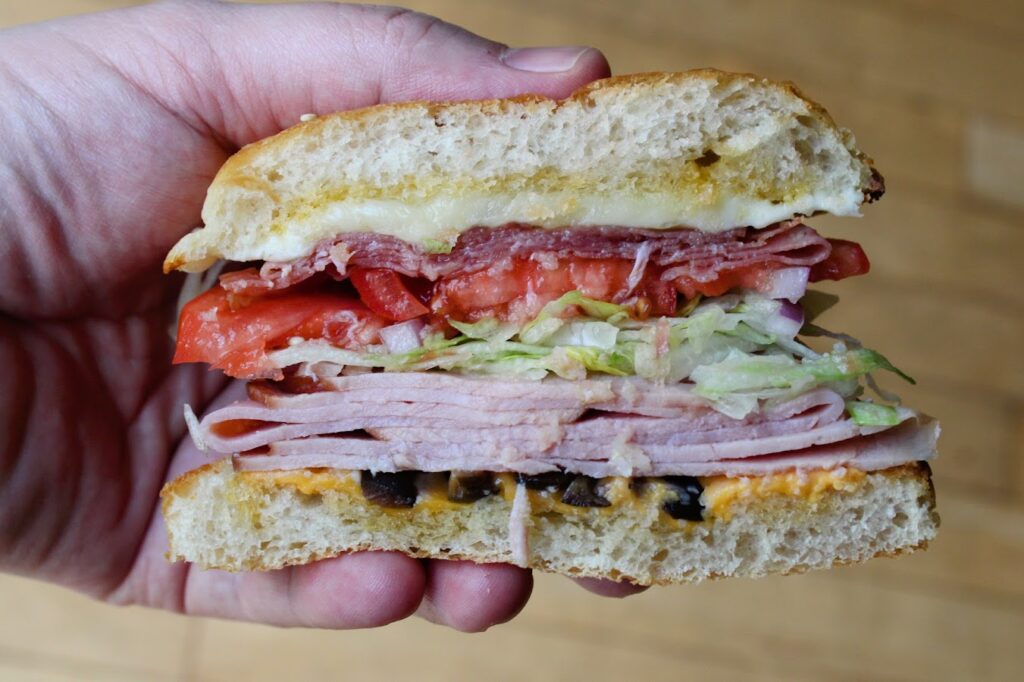
Is this muffaletta-adjacent sandwich from a fast-casual chain worth your time and money? This week I found out. I visited a fairly new location of Schlotzsky’s Deli in my area and then tried the sandwich that started it all.
I also spent a whole bunch of time testing a sourdough roll recipe that can be baked in 4, 5, or 6-inch round cake pans—or even bigger—and I built another calculator recipe you can use to create rolls similar to these.
Don’t have a sourdough starter? I cover an easy way to get started with sourdough baking, and then I also shared a way to make the same rolls without a starter in the full sourdough roll calculator.

I’m over here trying to cover all the bread bases. Read on to learn more about the sandwich and get into the meat, cheese, and veggies of the matter.
There’s a lot of content on this page, and some of you might want to skip around. Here are some navigation links that will let you jump over the sourdough content or my review of The Original sandwich if you’re just here for a discussion of sandwich ingredients.
What is this sandwich?
This sandwich blog post is my attempt to recreate The Original from Schlotzsky’s deli in my own kitchen.
According to Schlotzsky’s, this is the only sandwich on their menu when they first opened in Austin, Texas, in 1971. Original owners Don and Delores Dissman created this sandwich based on muffulettas that they had enjoyed in New Orleans, and you can still see the muffaletta inspiration in the sandwich.
In 1971, the original price for a Schlotzsky’s Deli sandwich was $2.91, and according to that article linked above, it was “as big as your head.” For reference, a McDonald’s Quarter Pounder with Cheese was around $0.70 in the 1970s.

The Original from Schlotzsky’s Deli contains ham and salami (some sources say two different types of salami), 3 cheeses in the form of cheddar, mozzarella, and parmesan, black olives, shredded lettuce, thinly sliced red onion, tomato slices, yellow mustard, and a signature sauce on a freshly baked sourdough sandwich bun. And instead of just one huge size of sandwich, Schlotzsky’s currently allows you to choose from small, medium, and giant-sized sandwiches.
Current pricing for The Original (not the deluxe version) from Schlotzsky’s Deli in June of 2026.
| Size | Price | Calories |
|---|---|---|
| The Original: Small | $7.59 | 490 cal |
| The Original: Medium | $9.19 | 750 cal |
| The Original: Giant | $15.99 | 1450 cal |
Almost all of The Original’s components are things that you can easily figure out and find replacements for. That is, except for the bread and the secret or “signature sauce.” I think I’ve figured out the sourdough bread and a technique to make it in several different sizes, but Schlotzsky’s signature sauce isn’t as easy to research. And to be honest, I’m not even sure if they put it on the sandwich I most recently ordered because I didn’t notice it at all.
Schlotzsky’s signature sauce?
I dug around the internet, and it seems like Schlotzsky’s signature sauce is either some sort of oil-based dressing or a combination of margarine and garlic, as you might find in the ingredients of store-bought garlic bread. Most copycat recipes online seem to buy a vineagrette dressing from the store and use that. But there are several mentions online from people who have worked at Schlotzsky’s locations who say the sauce is quite a bit simpler than that.

That screenshot above from an ex-employee 15 years ago gives us some sort of inkling as to what the Secret Sauce is. They say it’s simply a butter-flavored oil with garlic added. And they’re not the only ones.

The above quote that references garlic/butter/sesame oil is from 15 years ago, but this ex-employee from a year ago also claims that the special sauce was garlic butter “technically.”

Digging a little deeper into the internet, I found a video from North Texas Vegetable Gardening and Cooking on YouTube, which posted their own Schlotzsky’s Original sandwich recipe, and in the intro for the video, the host, Jill, states that she managed a Schlotzsky’s location in Arlington, Texas, around 40 years ago, which would have been in the 1980s.
In the video, Jill shows how she makes her version of Schlotzsky’s signature sauce from Amish Country Buttery Topping, which you can order online, with a sprinkling of garlic powder. Maybe Schlotzsky’s signature sauce is different now than it was back then, but the number of ex-employees claiming it’s just garlic butter-flavored oil encouraged me to put that into my version as well.
But if you’re anti-butter flavored oils, feel free to skip the sauce entirely or just add a small amount of your favorite vinegrette instead. As I said, I didn’t even notice a signature sauce on the Original sandwich I recently tried.
Schlotzsky’s sourdough rolls
As for the bread, this part is a bit easier since I’ve been working on sharing bread recipes for the last five years. First off, the restaurant says it’s sourdough, and we can see the rolls that Schlotzsky’s serves are large and baked in circular pans. There aren’t a whole lot of videos that I have seen from inside a Schlotzsky’s kitchen, but I found two somewhat helpful behind-the-scenes videos that show some of the process of baking the bread and building a Schlotzsky’s Original sandwich.
Below is a screenshot and an Instagram reel from the official Schlotzsky’s account. The screenshot is a still frame from the video displaying the layers of The Original that are made in the video. There may be more videos out there that have clues as to how the bread is made, but this one showed me most of what I was interested in seeing.

I did notice something in that video that I captured below in an animated GIF and still frames. They very briefly and pretty clearly show what appears to be instant yeast used in the Schlotzsky’s baking process.


I look at a lot of bread recipes online, and it’s not uncommon for instant yeast to be an optional ingredient in a sourdough bread recipe. Instant yeast is used in sourdough breads for two reasons. The first is that a lot of home sourdough starters might not be strong enough to provide all of the lift required to make a loaf of bread. The second reason is that adding a very small amount of instant yeast will shorten the time required for the dough to rise. Your corner bakery is probably not using instant yeast for its sourdough loaves because they have perfected the timing, and they have a sourdough culture that is very active and strong.
For an example of a professionally created sourdough recipe that uses instant yeast, you can check out this Rustic Sourdough Bread recipe from King Arthur Flour. In the tips section below the recipe, they explain why you might want to use instant yeast in the recipe and how much to use.
Because of the fact that instant yeast is visible in Schlotzsky’s video above and because it truly does make a big difference in the time required for baking sourdough, I have added it as an optional ingredient in my recipe as well.
Now that we have our sandwich in target, we need to make bread. But first, I need to get started on the sourdough starter.
Schlotzsky’s Original recap
During the process of testing my sourdough roll recipes, I made the short trip south to try the closest Schlotzsky’s Deli to my house. This was my first visit to Schlotzsky’s since I lived in North Carolina more than 20 years ago. I visited the Gateway Plaza Schlotzsky’s in Chicago’s Illinois Medical District near Rush Medical Center and just south of the United Center.
I ordered The Original in medium size, and my wife got a turkey sandwich in their small format, so I got refreshed on how big their bread and sandwiches are. The small-sized roll is around 4.5 inches, and the Medium is close to 6 inches in diameter. The bread was fairly flat, but it had a pretty open crumb.

Overall, both sandwiches were pretty good. The Original was not very heavy on ingredients, which meant the major flavors that I tasted were mustard and olives. But the bread was soft in the middle and nice and crispy on the outside, which worked well with the other textures in the sandwich, like the ham.


Would I order The Original again? Yes, definitely. Next time, I might get the small size and then order the Deluxe version, which upgrades the amount of meat for a bit more money. I felt that the only downside of the sandwich was the amount of ingredients for the width/diameter of the bread.
Now that I’ve got a good handle on the sandwich, it’s much clearer as to why we might want to make this one at home, because we can control the size of the bread as well as the amount of each ingredient. Spoiler alert: my versions of The Original are better than Schlotzsky’s because of this.

New sourdough starter
I have some pretty bad news about my last sourdough starter. Just like the person he shared a birthday with and was named after, James Earl Starter Jr is no longer with us. Pour one out for Jimmy Starter. If you’ve been reading along for a while, you likely know that I bake a whole bunch, but I do not bake with sourdough that often. I typically keep my sourdough starter in the refrigerator between sourdough sessions, and this time, I think it was just much too long, and the starter didn’t fully recover when I tried to bring it back to life.
So, I’ve started a new starter. Or more specifically, I bought a San Francisco-style sourdough starter off the internet and started feeding it. So, unfortunately, Jimmy Starter has died, and I had to name my new starter.

You can read more about my now deceased sourdough starter in the blog post I wrote when I created a sandwich for Jimmy Carter.
My wife and I have been binging the TV show ER from the beginning, and when it came time to name the new starter, I asked her if she had any ideas. She thought about it for a minute and then shouted out, “Dough-ah Wyle!” This suggestion seemed like an aha moment, and the name stuck. This works shockingly well because Noah Wyle plays a character with the last name of Carter in the show, which matches my last starter.
Long version of my new starter’s name: Dough-ah Wyle as John Truman Starter III, M.D.
What is a sourdough starter?
If you know nothing about sourdough and how it’s made, a sourdough starter can be created from just two ingredients that you mix together: flour and water. A third ingredient, naturally occurring yeast—which is floating in the air around you right now—will eventually introduce itself to the mix. The yeast eventually finds your starter that’s open to the air, and it will start eating the sugars in the flour and expelling carbon dioxide. Eventually, you will start seeing bubbles forming in the paste created by flour and water, and that tells you that yeast has started eating and the starter has begun.
You “feed” a sourdough starter by removing some of its bulk and adding a fresh amount of new flour and water to what is left of the mixture. The living yeast will find new flour, and it will start eating and expanding due to the expulsion of gas. With regular feedings, you can keep a sourdough starter alive for hundreds of years or even longer. Bakers have even found old, crusty yeast in ancient pots and used that to bring life to bread.
My first starter was created the natural way by leaving it out to accept naturally occurring yeast. This typically takes more than a week. But you can jumpstart the whole process by buying or obtaining starters from local bakeries, or you can buy dried starter online. In the past, I tested a starter that I purchased from King Arthur Baking, but Dough-ah Wyle, my current sourdough starter, was purchased dried, and I fed it flour and water to bring it to its current form.

So far, Dough-ah is working just fine, and it produced some of the bubbles in all of the breads I used during the process of making the Original sandwiches.
Circular sourdough bread rolls
Schlotzsky’s uses small pans to create the rolls that they serve. One of the reasons that they use a pan is for consistency, but the other reason is that they’re using a dough that’s very sticky. A sticky dough is difficult to shape, but using a pan means the bakers at Schlotzsky’s can simply dollop the dough into the greased and/or cornmeal-dusted pans, and the dough will rise and fill in the pan on its own.
They’ve got this down to a very polished process, I’m sure, since they are supposedly baking every day in each location. For us, though, the whole process is actually pretty easy from a baker’s standpoint—other than feeding and keeping your sourdough starter alive.
Basically, you stir the very sticky dough until all ingredients are well combined. Allow the dough to rise. Portion and spoon dough into your prepared baking pans, allow to rise again, and then bake. Similar to a focaccia, this roll requires no real shaping and no intensive kneading.


This recipe works in a calculator format like my focaccia and pan pizza calculator because the rolls are baked in pans. Using something known as baker’s percentages, we can scale the numbers up or down to match the area inside the baking pan.
Very nerdy high school math time
You can skip this part if you’re a math teacher.
If you don’t remember how to figure out the area of a circle from your high school geometry, the formula is π r², which is pronounced in English as “pi R squared,” where R is the radius of the circle you’re trying to calculate, and pi is roughly 3.14. So if we have a 5-inch pan, the radius would be 2.5 because the diameter is 5. Figuring out the area of a 5-inch pan would be 3.14 x 2.5² or 3.14 x 6.25, which equals 19.63.
Now we just need to figure out how much dough would go into a circular pan with an area of 1, and then we can scale it to a pan with any area with simple multiplication. This part took a little fiddling, but eventually I think I nailed it.
Still reading? Keep going, that’s all the math for today’s sandwich blog.


In all of my test batches, I felt that for a good, hearty sandwich similar to what they serve at Schlotzsky’s, a 5-inch cake pan worked the best. If you wanted a smaller size, you should use 4-inch pans. You could also make a much larger 8 or 9-inch roll if you wanted and then cut it into wedges to become multiple sandwiches. The bread for Schlotzsky’s medium-sized sandwiches is about 5.5 inches round, so the 5-inch diameter pan works well for me. You could always buy 6-inch pans and use the calculator to make that work for you.


Schlotzsky’s Deli does not use an egg wash on its rolls. They do sprinkle them with sesame seeds, but the lack of the egg wash means the tops will not be extra dark, and typically, an egg wash will be the glue that holds sesame seeds onto the roll. This means that many of the seeds will fall off after baking. To combat this, I like to lightly press some of the seeds into the dough. Try not to press too hard, though, or you will deflate the gas that has built up inside the dough.


Can I make these rolls without a sourdough starter? Yes. I put this in the notes above the full recipe, but if you do not have a sourdough starter, you can still make these rolls. Look at the amount of sourdough starter that the recipe calls for, divide it in half, and then add that much water and flour. So if the recipe calls for 100 grams of sourdough starter, that means you need to add 50 more grams of flour and 50 more grams of water.


Here’s my sourdough roll calculator. If you like this sort of content, I’ll be using the sourdough roll calculator again in next week’s sandwich as well.
Sourdough roll calculator
This tool will build an ingredient list to help you create a sourdough roll to fit the size of the round pan that you want to use. Enter the size and numbers of your pan or pans and the Sourdough roll Calculator will do the rest.

Two or possibly three meats
The menu listing for The Original says ham and salami are the meats used. There are several other places where I’ve read that there are two types of salami in Schlotzsky’s Original, but always ham is mentioned. For my sandwich, I kept it simple and just used deli-sliced ham and either Genoa salami or sopressata (which is what I originally had in my fridge). I did not make any sandwiches with three meats, but I put in the full recipe below, which meats I think would work great if you wanted to make this sandwich at home.

I am not an Italian meat specialist, but it seems to me that in my grocery stores, Genoa salami is the most commonly available. And Genoa salami works great with ham as well. I could tell that there was ham and salami in the Original that I got at Schlotzsky’s, but there wasn’t enough meat on my sandwich to recognize or tell which salamis they were using. If you’re making your own, just get some Genoa salami and deli-sliced ham, and you should be good to go.
Three cheeses
The Original contains three different cheeses in the form of cheddar, mozzarella, and grated Parmesan cheese. I really like this technique because cheddar is placed on one side of the sandwich roll, and mozzarella goes onto the other side. Both are topped or combined with grated Parmesan cheese and then broiled. At Schlotzsky’s, they have a conveyor belt-style broiler that is used to heat up both the meat and the cheese, but this is easy enough to accomplish in a toaster oven or under the broiler in your oven.
If you do not have a broiler, you can still do something very similar in a 375-degree F (190 C) oven for about 5 to 7 minutes.

Signature sauce
A lot of people on the internet who have Schlotzsky’s Deli sandwich copycat recipes will just use an oil and vinegar-based sauce or some sort of garlic dressing for the “signature sauce.” But as I posted above, from several people who claim to be ex-employees or ex-managers of Schlotzsky’s, it seems like the signature sauce is a margarine or oil-based sauce with garlic and salt added. At least one person, who happens to be an ex-manager of Schlotzsky’s Deli, uses “buttery topping” in her sandwich recipe, so I tried that.
You can order Amish Country Buttery Popcorn Topping directly from their website, or you should be able to find something very similar in the popcorn section of your grocery store.
I’m not an expert on store-bought buttery topping, but from the two brands I have studied, it’s typically made from a neutral oil like soybean oil, with buttery flavoring added. The main flavor and color additions to the buttery topping are diacetyl, which is a product of fermentation that contributes buttery flavor, and annato seed, which is purely used for coloring. Basically, you can think of a store-bought buttery topping as margarine that doesn’t contain the emulsifiers and other ingredients that cause it to become spreadable. If you wanted to recreate Schlotzsky’s signature sauce and you’re hesitant about margarine or soybean oil, you could use ghee and add garlic powder or finely minced garlic instead.

You could also leave this ingredient out entirely, or you could just use your favorite vinegar-based salad dressing. This would create a bit of a different flavor, but it would still be tasty and would work well with the other ingredients.
Veggies
Schlotzsky’s Original comes with four different vegetables: shredded lettuce, sliced tomatoes, thinly sliced red onion, and marinated black olives. The combination brings a bit of freshness as well as various textures, which help to balance out the melty and creamy cheeses.
Lettuce, tomato, and red onion seem like typical deli-style sandwich components, but black olives aren’t quite as typically seen in sandwiches like this. The olives do start to make sense when you think that possibly this Original Schlotzsky’s sandwich got its inspiration from the muffaletta.

Anyway, if you’re making this sandwich in your own kitchen, you can obviously pick and choose which veggies you prefer. I personally think the olives, due to their flavor, and the lettuce, due to its texture, both add the most and seem to be the most important of the four options.
Sandwich cooking process
Schlotzsky’s Deli has a conveyor belt-style broiler to toast bread, melt cheese, and warm up meat. I’m assuming that you do not have one of those, but we can easily replicate their process in an oven with a broiling element. I used my toaster oven, but a regular oven would work as well.


Sandwich build process
After the cheese, meat, and bread get a little toasty, it’s a fairly easy build process. Stack the meats up, top with lettuce, red onion, tomato (lightly salted), and then a circular drizzle of yellow mustard on the top bun. After that, you’re all set.


Photos and recipe
Overall, this is a pretty easy sandwich to make, and if you put things together properly, it has a high return on your investment.
Here are some photos of the Schlotzsky’s Deli Original sandwich copycat that I made this week. Just a bit further down the page is the full recipe, and if you missed it, the sourdough roll calculator would also be very helpful if you wanted to recreate the whole Schlotzsky’s experience.
Let me know if you try either of these recipes and tag me on social media if you share photos!


The Original sandwich (Schlotzsky's Deli copycat)

This ham and salami sandwich is paired up with warm and melty cheddar, mozzarella, and Parmesan. If you wanted to replicate the true Schlotzsky's experience, you'll have to make the sourdough sandwich rolls as well.
You: "Mom, can you bring home Schlotzsky's? "
Ur Mom: "No. We've got Schlotzsky's at home."
Ingredients:
Signature sauce- 1⁄4 cup butter-flavored oil (you can find this near the popcorn - or you can use olive oil)
- 1 teaspoon garlic powder
- 1⁄2 teaspoon salt
- 1 round sourdough sandwich roll (recipe here)
- signature sauce (from above)
- 3 to 4 tablespoons cheddar cheese, slice or shredded
- 3 to 4 tablespoons mozzarella cheese, shredded
- Parmesan cheese
- 1 to 2 tablespoons black olives, chopped
- 2 to 3 slices of deli-style ham
- 2 to 5 slices of salami (about the same amount as the ham)
- 1 cheese covered sandwich roll (from above)
- iceberg lettuce, shredded
- red onion, thinly sliced
- 1 to 2 tomato slices
- yellow mustard
Directions:
Combine the signature sauce ingredients in a small bowl and whisk together. This can be stored in a sealed container on the counter it does not need to be placed in the refrigerator.
Grab a sheet pan and cover it with aluminum foil so you won't have to clean up the pan.
Slice your roll and drizzle 1 to 2 teaspoons of signature sauce on the inside of both the top and bottom slices of bread. Place both pieces of bread on the foil-lined pan.
Place cheddar cheese on the bottom roll and place mozzarella on the top roll. Sprinkle some Parmesan cheese on both sides. Top the cheddar cheese with some chopped black olives.
Place a sandwich-sized pile of ham and salami directly on the foil. Broil the meat and cheese-topped bread for 4 to 5 minutes or until the bread is toasted lightly and the cheese is fully melted.
Place the warm ham on the cheddar cheese, and then top that with lettuce, thinly sliced red onion, and your tomato slices. Lightly salt the tomato.
Place the salami on top of the tomato slices, and then squirt some yellow mustard on the top of the roll. Close the sandwich, slice it in half, and serve.
Check back next week
Because it took me a few attempts to get my round sourdough sandwich bun recipe up and running, next week I plan to use the same base recipe with some cheese and spice added. Then I’m going to use it in a different sandwich. This is like a two-parter to-be-continued sort of situation. Come back and find out what we’ll be eating!

Dan Finn says:
Schlotzsky’s!!!!!! When we got one in Westmont, IL, where I am from, it was considered so exotic.
Jonathan Surratt says:
I used to go 20+ years ago when I lived in NC, but haven’t since then because I didn’t have any nearby. The one in Chicago has only been there since last year, sometime, I think. The experience and the sandwich were about what I remembered from a while back.