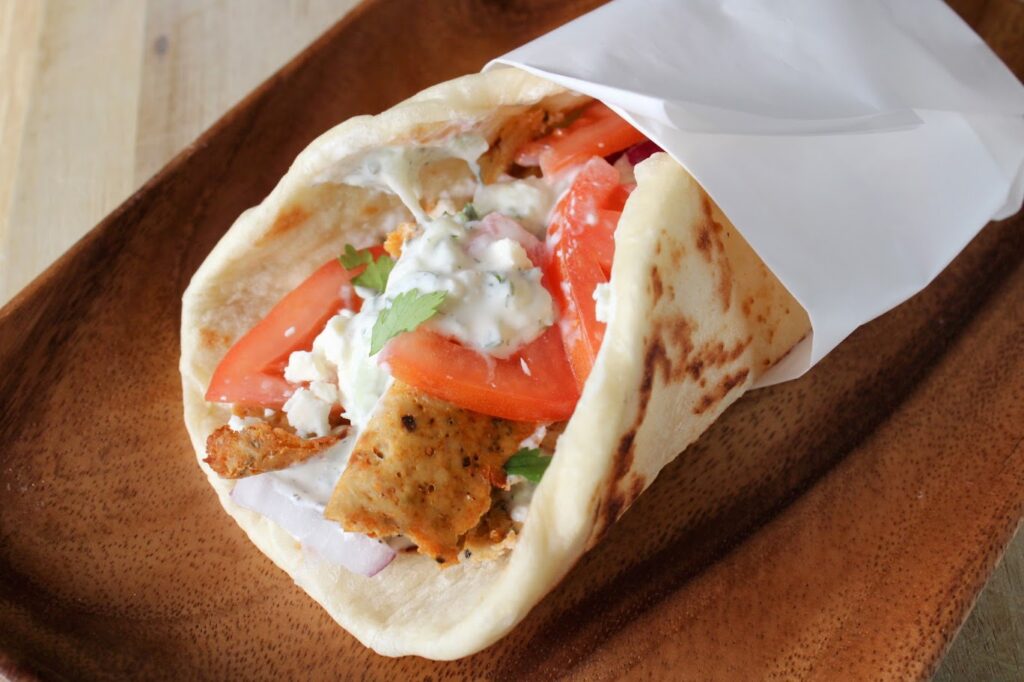
This week, I tried another viral recipe that usually uses ground beef or lamb, with the goal of converting it to use ground chicken. Some might say this is doner kebab meat, which some might argue can also be gyro meat. It’s not an authentic recipe, and I’m not 100% sure which one it is, but I know that it’s tasty, and I’m going to use turn it into a flavorful handheld sandwich-adjacent adventure.
In Greece and many parts of the world, gyros is pronounced like: YEE-ros.
In some places, like NYC, they pronounce it like JAI-ros.
What is this sandwich?
It’s a gyro, an Americanized one.
By some definitions, this is not technically a sandwich; it’s more of a handheld folded flatbread. This is my attempt to create a recipe for a chicken gyro that is stuffed with warm, slightly crispy meat, veggies, and a greek yogurt based sauce.
The base for these gyros uses a viral doner kebab hack that’s been sweeping Instagram and TikTok over the past few months. But instead of beef or lamb meat, I used ground chicken with a few spices and a couple of purposeful tricks to keep the meat nice and juicy.
I’ve written about sandwiches with flavors that are adjacent to the gyro before, so if you’re a regular reader, some of this might seem similar to blog posts you’ve seen before, but the preparation of the meat is unique, and it really works well after I tweaked and adjusted the spices and ingredients.
This recipe is making doner kebab meat, but it’s being used in a gyro. What’s up with that?
Here’s one of the first viral doner meat hack videos I saw. Or at least the first one I remember paying attention to.
Difference between a doner kebab and a gyro?
Please note: I am not a Food Historian, nor am I a specialist on the difference between gyros and doner kebab. I’m also not claiming that the gyro I’m making today is an authentic Greek version either. But it does taste good.
Doner kebab (also spelled döner kebab) and gyros are very similar in how they’re made and served. The two handheld meals are definitely related. It seems likely that doner kebab was created first, and the Greeks altered the meat choices and topping selections, turning it into what they ended up calling a gyro. More likely, they are both variations of similar Middle Eastern dishes consisting of meat served with flatbread.
One main thing that doner kebab and gyros have in common is how the meat is cooked. It’s typically cooked with spiced meat stacked on a large skewer, spinning over or beside a heat source. The word döner in Turkish translates into English as “rotary,” and the cooking method involves a heat source called a rotisserie, rotisserie grill, or upright grill that the meat skewer spins beside or above to brown the exterior pieces.

We’ve already established that both doner kebab and gyros are served with flatbread. In the case of gyro, it’s typically a bread called pita, but doner kebab might be served with other types of thin bread with names like pide or dürüm (which means wrap or roll in Turkish).
Where doner kebab and gyro most differ is when it comes time to pair the meat and flatbread with accompaniments. Both often contain “salad,” which might be things like tomato and white or red onion, and often, cucumber will be a component. But doner kebab might be served with roasted vegetables and a variety of different sauce options, while a gyro is mostly sauced with a yogurt-based tzatziki.
Gyro history
Food offerings that are similar to gyros go WAY back into history. Serving meat and/or veggies on or alongside flatbread likely goes back as far as the invention of bread itself.
The modern-day gyro, as it’s known in restaurants in Greece and eventually around the world, came to be in the early 1920s. During that time, there was a large government-forced population exchange between Greece and Turkey, and with them, the displaced immigrants who were originally living in Asia Minor brought their tradition of cooking stacked meat on a vertical spit to Greece. Small mom-and-pop-owned shops started popping up, selling meat folded up inside flatbread. In the beginning, in Greece, gyros were typically made from pork.
The end of World War II boosted the interest in Greek gyros and lamb as gyro meat became popular due to Middle Eastern immigrants coming into Greece.

By the 1970s, gyros were still very popular in Athens, but they had gathered a strong presence in New York City and Chicago due to the influx of Greek citizens migrating to those large cities. Chicago specifically was home to a very large beef processing, packing, and transportation industry, so bringing beef into the gyro mix alongside lamb was a natural progression. Chicago’s PBS affiliate, WTTW, has a great article about the history of gyros in Chicago that you might want to read if you need more gyro history.
The gist of the later history of the gyro does take place in Chicago, and it’s mostly due to a Chicago engineer named Peter Parthenis. Parthenis was asked by restaurateurs to create a vertical rotisserie (this is an archived NYTimes article from 2009—no paywall) that could be serviced locally with locally sourced parts. The current rotisseries at the time were from Greece, and they weren’t easy to work on or replace. Parthenis’ rotisseries worked well, and he ended up forming a company called Grecian Delight that sold the meat for gyros already formed into cones that could be frozen, shipped, and then warmed in those rotisseries. This was a very good move for his company that ended up ensuring the customers who bought his rotisserie ovens continued being customers and kept buying his products.
The company Grecian Delight eventually merged with a company named Kronos Foods. Kronos was and is still located outside of Chicago in Glendale Heights, Illinois. The company has specialized in producing Greek food for restaurants and stores since it was founded in 1975.
Kronos gyros marketing posters
If you live in Chicago and frequent Greek restaurants or hot dog stands that also sell gyros, you’ve no doubt seen marketing posters for gyros that were created by Kronos Foods. Typically, these posters featured young female models, smiling and holding a gyro, and they were especially prevalent in the 80s and 90s. In this article from 2005, Kronos’ founder Chris Tomaras points out that he selected the first Kronos girl, and the choice was a blonde. Tomaras is quoted as saying that “the idea was to not have a Greek-looking girl but an American girl.”
Eventually, Kronos Foods began promoting their gyros using non-blonde models (not 4 Non Blondes, though), and it is still very likely you’ll see one of their posters in Chicagoland area restaurants that serve their gyro cones.


The internet claims that the blonde model in the posters above is Jane Boal, who worked for the TV station WGN for years. I did not reach out to Boal to confirm, but she does have her own communications company if you need some help in that department. Tell her some guy who writes a sandwich blog sent you.
Let’s get down to business and make some chicken gyros. Now that we know what we’re making, first we need some soft pita to stuff with meat and veggies.
Homemade pita two ways
I have shared an oven-baked pita recipe a few times before, and when I’m trying to make sure that I get a pocket inside the bread, I prefer to bake the pita. But I actually would rather cook flatbread on top of the stove. Both processes start with the same dough recipe, and they both require rolling or stretching to get a roundish shape, but they differ when it comes time to cook. Since I typically stove-griddle the pita, I created a second recipe to share that highlights that process.
It’s difficult to not say the phrase pita bread. But you shouldn’t. The word pita itself means unleavened bread, so it’s like saying ATM machine.
The hardest part about making round pita is trying to get the dough to be a circle. After you’ve made the recipe a few times, it becomes easier, but most of the process relies on the dough being allowed to relax just a bit after you stretch and roll it. After the dough relaxes for 5 or 10 minutes, you should be able to go back to it and stretch it even further. I typically will work on two dough portions at the same time, going back and forth from one to the other to give each time to relax while you work on the second dough.
I like to work directly on a clean countertop, which plays to my advantage because I use the slight bit of dough stickiness to help get consistent circles. I do not add extra flour during the shaping step, because that will remove the sticky bits of the dough and will force the circles that you make to relax and shrink after you roll them out.


Stovetop pita method
If you’d prefer to cook your pita in a pan or on a griddle on top of the stove (or on your gas or charcoal grill), you should use this recipe.

Simple pita (stovetop method)
Need a quick flatbread recipe for your next gyro night? This recipe has you covered with a soft, pliable pita that you cook on the stovetop in a pan or griddle.
Get RecipeOven pita method
Or if you’d prefer to bake your pita, here’s my tried and true recipe for hopefully producing pita that creates pockets.

Simple pita (oven method)
This recipe yields six soft pockets of bread for stuffing. You can use this recipe for pita pockets, or you can enjoy them folded like a gyro or a big puffy taco shell.
Get RecipeGyro chicken meat
The viral doner kebab technique is a super-easy method to create meat that is very similar to the gyro meat you get when you order from a restaurant with a rotisserie oven. I have seen many YouTube videos or social media posts where cooks or chefs will use a rotisserie on their gas grill or a spit in their home oven. But in my opinion, that’s not overly practical for most home cooks.
A rotisserie cooking gyro meat works in a restaurant setting because they are serving many people, potentially at once. They will be using a large hunk of meat that they can slice quarter-inch slices off the cone, and then, while serving what they just sliced, the rest of the meat on the cone will have time to do a few revolutions in the rotisserie and get toasted and slightly charred. It just isn’t that practical to try to replicate this at home unless you’re having a party.
This viral technique produces flattened, seasoned meat that attempts to texturally recreate the experience of meat that has been shaved off a skewer. It’s all done in the oven, so it’s a pretty easy cooking process that mostly just requires mixing some ingredients in with the ground meat.


I was thinking of tricks for keeping the ground chicken moist and how to keep it from drying out. It’s very important that you add the grated onion because it definitely helps bring some moisture to the final chicken. When I was formulating the recipe, I thought about meatloaf and remembered a technique of using quick oats in a turkey meatloaf that they invented at America’s Test Kitchen (this article will likely be behind a paywall).
That ATK article mentions that they ended up scrapping a breadcrumb mixture that a lot of meatloaf recipes use and instead started using quick oats, which, in their many tests, helped accentuate the texture of the meat without drawing too much attention. Even though they were making chicken meatloaf, I decided to try that in my gyro chicken mixture. And in my limited experience, it seemed like the oats also ended up absorbing some of the fat and liquid and holding onto it, helping things stay a bit more moist.
Both the grated onion and the quick oats contribute to the finished meat in my tests with and without them, and I think they were very helpful in keeping the chicken meat from creating a dry gyro.


The cooking process takes place in the oven. You spread the seasoned meat out thinly on parchment and then roll it up. The meat cooks inside the paper, which helps to cook it through while steaming and firming up the texture of the finished meat.


Once the meat is unwrapped from the parchment, it’s fully cooked and ready to be used, but right before serving, I like to either place the meat under the broiler briefly or warm it up in a skillet to give the meat just a little bit of crispiness around the edges.
Tzatziki sauce
Tzatziki sauce is a Greek sauce that’s made from Greek yogurt, grated cucumber, garlic, dill, and lemon juice. The sauce turns out creamy with fresh notes from the dill and cucumber, and a little bit sour and tart from the lemon juice and creamy Greek yogurt.


Here’s the tzatziki sauce recipe I used. You can also buy some at the store if you prefer. After all, you’re the boss of your sauce.

Tzatziki yogurt sauce
A cucumber-focused, slightly tangy, and creamy sauce that's a perfect accompaniment to falafel or your next Greek-style gyro or sandwich.
Get RecipeVeggies and Feta cheese
My perfect gyro would include a couple of sliced tomatoes, some thinly sliced red onion, and a bit of crumbled feta cheese. Some gyros might include some cucumber slices, or they might forgo the red onion for white onion.
But in my opinion, these are the ingredients that I want. I will also sprinkle cilantro on top of my gyros, but that’s probably more of a personal taste; you can use parsley or just skip the garnish altogether since all of these veggies are technically a garnish. A bit of lemon juice is also a good garnish if you have some leftover from adding to the tzatziki.

Chicken gyro photos and recipe
Here are several photos of the chicken gyros I made this past week while testing my doner-style chicken recipe. Scroll down just a bit to get the full recipe.


Easy chicken gyro

This chicken gyro recipe creates the texture of crispy meat sliced from a rotisserie in a simple oven-baked method. Pair that with a soft pita and tzatziki salad to build a great gyro experience.
Ingredients:
Chicken gyro meat- 1 pound ground chicken
- 1⁄4 onion grated (about 3 tablespoons)
- 1 1⁄2 tablespoons quick oats
- 2 tablespoons whole milk Greek yogurt
- 1 1⁄2 tablespoons olive oil
- 2 teaspoons paprika
- 2 teaspoons ground cumin
- 1⁄2 teaspoon dried oregano
- 1 teaspoon salt
- 1 teaspoon ground black pepper
- 1 tablespoon fresh lemon juice (drizzle on after cooking)
- 4 six to eight-inch pitas (link to recipe)
- tzatziki sauce (link to recipe)
- chicken gyro meat (from above)
- tomato slices, quartered
- red onion, sliced
- cilantro or parsley (garnish)
Directions:
Chicken gyro meat: preheat your oven to 400 F (205 C).
Combine all of the chicken gyro ingredients (except for the lemon juice) in a large bowl.
Separate the meat mixture into two halves and place one half right in the middle of a sheet of parchment about 20 inches long. Top the meat with a second similar sized piece of parchment and flatten the meat until it's about a quarter inch thick. Using your hands or a rolling pin, make sure the meat mixture is about the same thickness throughout.
Remove and discard the top sheet of parchment.
Roll the parchment with the flattened meat mixture on top in about 2-inch wide folds. If you want more context with photos on how to make and wrap the chicken, check out the accompanying gyro blog post.
Repeat this process with the second half of the meat mixture and two more sheets of parchment.
Place both parchment-folded meat mixtures on a sheet pan and bake for 18 minutes.
Remove the sheet pan and allow everything to cool for 10 minutes before removing the meat from the parchment and ripping it into smaller pieces or strips. Sprinkle a little lemon juice on top of all of the meat, and at this point, you can make gyros, or you can move the meat to a sealed container into the refrigerator until time to use.
Gyro assembly: In a medium pan over medium heat, warm your pita. This should take only 1 to 2 minutes per side until the pita has softened and is warmed through.
Remove the pita to a plate and add 1 teaspoon of olive oil to the pan that's still over medium heat. Once the oil has a minute to warm up, add enough meat for your pita and move it around to get the meat covered by the oil. Cook for 1 to 2 minutes per side until the chicken is warmed through and slightly crispy. Now it's time to build the gyro.
Spread about a tablespoon of tzatziki down the middle of the pita and top it with warmed chicken gyro meat.
Add slices of tomato and sliced red onion on top of the meat, and then add more tzatziki if desired. Garnish with cilantro or parsley and serve.
Check back next week
Next week we’ll be tackling another biscuit sandwich. No, not that one. No, not that one either. Keep guessing, you’ll get it. Probably.